Comparative Analysis of Monthly Reports on the Oil Market
Monday 14 September 2026


Summary
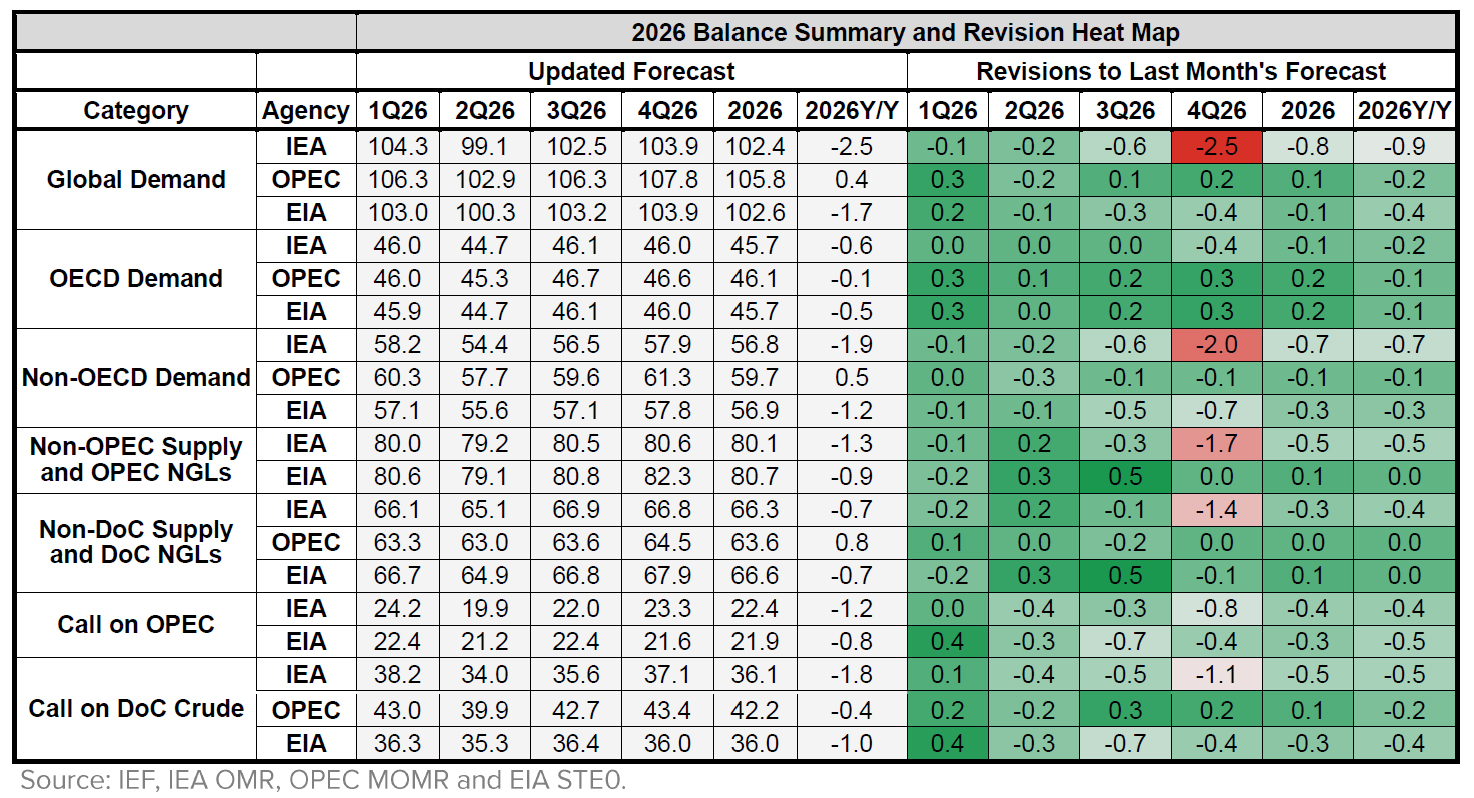
A widening gap between the major oil market outlooks shows the growing uncertainty shaping projections for 2026. While OPEC continues to expect modest demand and supply growth, the EIA and IEA both expect contractions, with the IEA projecting the largest decline in demand. The picture changes markedly in 2027, when demand forecasts converge around a strong rebound of 2.4-2.6 mb/d.
Demand
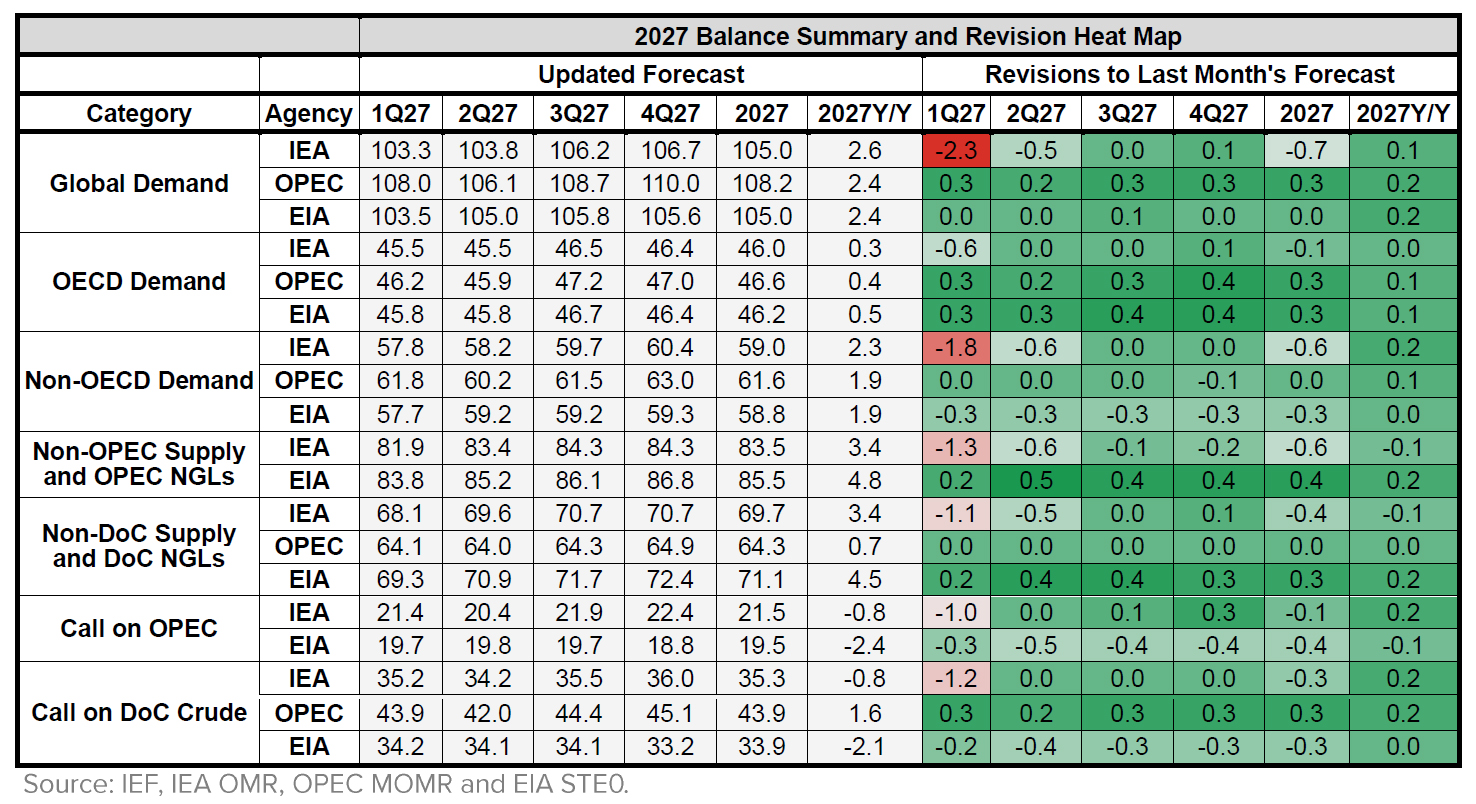
OPEC: OPEC see s global oil demand growth of 0.4 mb/d year-on-year in 2026, a downward revision of 0.2 mb/d from its previous forecast. Demand is expected to decline by around 0.1 mb/d across OECD economies, while non-OECD demand increases by 0.5 mb/d. In 2027, OPEC expe cts global demand growth to accelerate to 2.4 mb/d, an upward revision of 0.2 mb/d from its previous forecast, driven primarily by an increase of more than 1.9 mb/d in non-OECD economies, alongside growth of 0.4 mb/d in the OECD.
EIA: The EIA projects global oil demand to decline by 1.7 mb/d year-on-year in 2026, a downward revision of 0.4 mb/d from last month's forecast. Demand is expected to decline across both OECD and non-OECD economies, by 0.5 mb/d and 1.2 mb/d, respectively. The EIA expects global oil demand to rebound by 2.4 mb/d in 2027, an upward revision of 0.2 mb/d from last month's forecast.
IEA: The IEA forecasts global oil demand to decline by 2.5 mb/d year-on-year in 2026, a downward revision of 0.9 mb/d from its previous forecast. The contraction is driven primarily by non-OECD economies, as disruptions to petrochemical activity, refined product supply constraints and elevated diesel prices weigh on consumption. In 2027, the IEA expects global oil demand to rebound by 2.6 mb/d to around 105 mb/d, driven primarily by growth of 2.3 mb/d in non-OECD economies.
Supply
OPEC: OPEC expects non-DoC liquids supply and DoC NGL production to grow by 0.8 mb/d year-on-year in 2026, reaching a combined 63.6 mb/d, with growth led by the United States, Brazil, Argentina and Canada. In 2027, OPEC expects combined production to increase by a further 0.7 mb/d to around 64.3 mb/d, with Qatar, Argentina, Canada, Brazil as the main contributors to growth.
EIA: The EIA sees non-DoC liquids supply and DoC NGL production to decline by 0.7 mb/d year-on-year in 2026, averaging 66.6 mb/d. Supply expects to fall to 64.9 mb/d in the second quarter before recovering to 67.9 mb/d by the fourth quarter. The EIA expects production to rebound strongly by 4.5 mb/d in 2027, reaching 71.1 mb/d, with quarterly supply rising from 69.3 mb/d in the first quarter to 72.4 mb/d by the fourth quarter.
IEA: The IEA expects non-DoC liquids supply and DoC NGL production to average 66.3 mb/d in 2026, representing a year-on-year decline of 0.7 mb/d. Supply reaches a low of 65.1 mb/d in the second quarter before recovering toward year-end. A strong recovery is projected for 2027, with production increasing by 3.4 mb/d to 69.7 mb/d and reaching 70.7 mb/d in the second half of the year.
2025-2027 Balance Summary
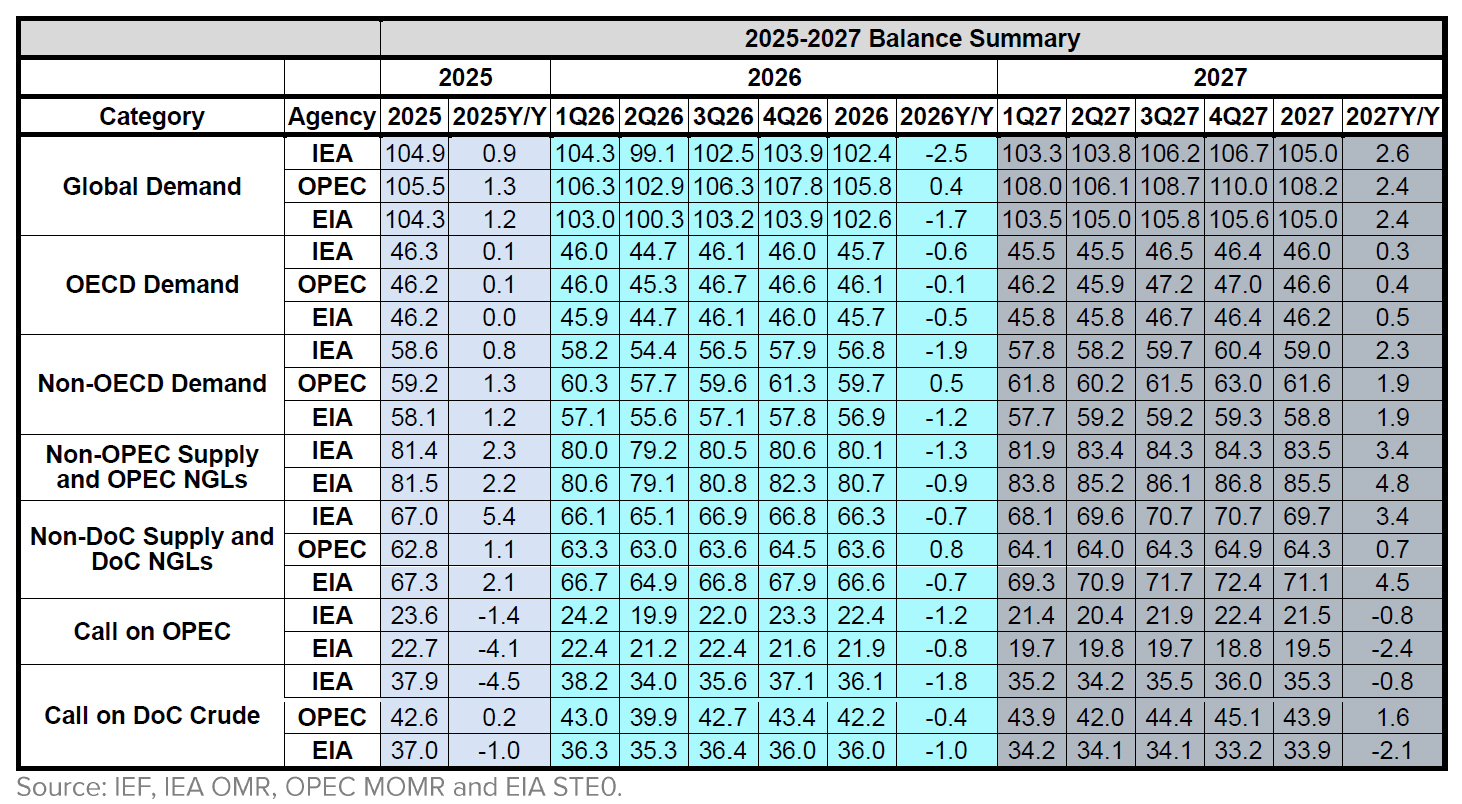
The three major outlooks present sharply contrasting views of oil demand in 2026. OPEC remains the only agency expecting growth, at 0.4 mb/d, taking global demand to 105.8 mb/d. In contrast, the EIA anticipates a 1.7 mb/d decline to 102.6 mb/d, while the IEA projects a steeper 2.5 mb/d contraction to 102.4 mb/d. The difference between the highest and lowest estimates therefore reaches 3.4 mb/d. The outlook becomes more aligned in 2027, with projected growth narrowing to 2.4-2.6 mb/d, although absolute demand estimates remain widely separated at 105.0-108.2 mb/d.
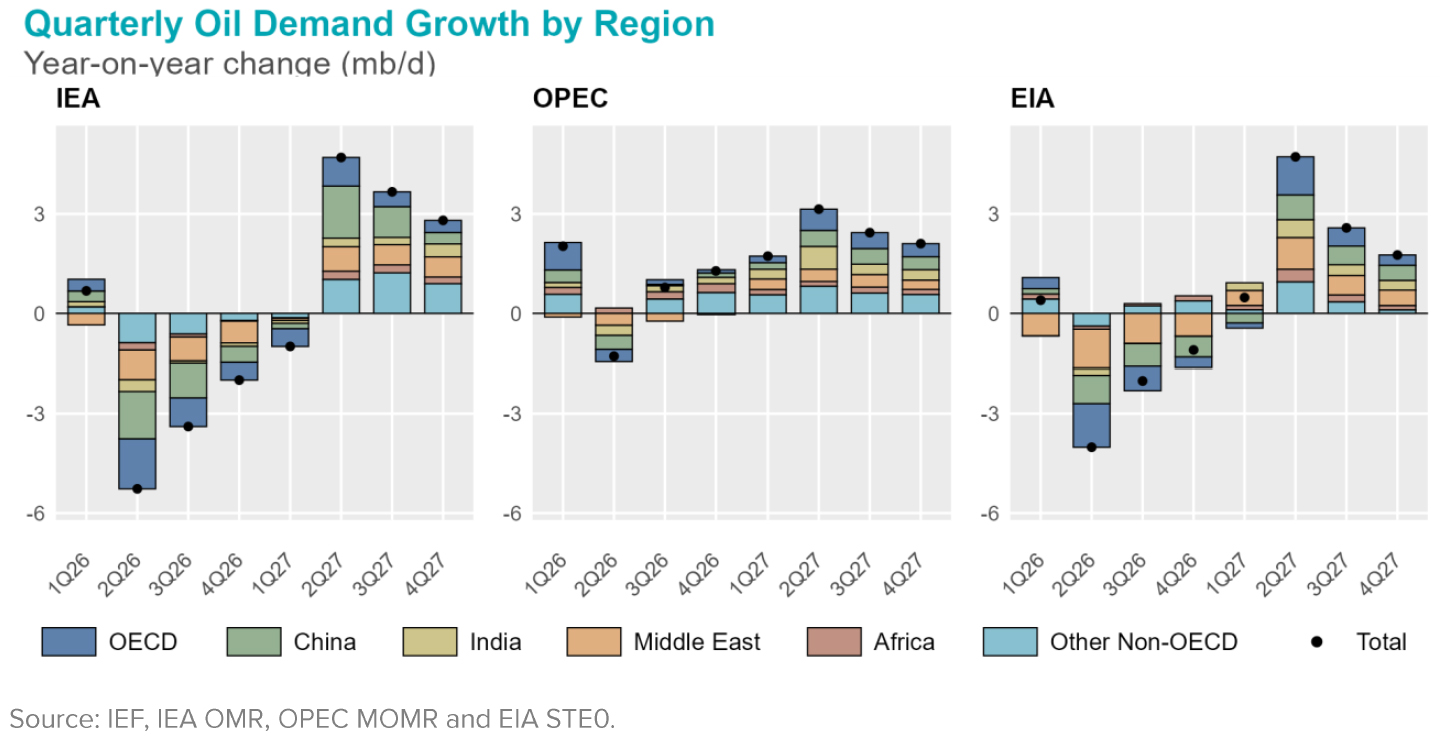
Quarterly demand projections diverge substantially across the three outlooks in 2026. The spread increases from around 1.6 mb/d in 1Q26 to 4.0 mb/d in 2Q26 and reaches approximately 4.2 mb/d in 3Q26, before narrowing to 3.3 mb/d in the final quarter. Differences emerge across both OECD and non-OECD demand, with China and other emerging economies contributing alongside sizeable variation in OECD projections. In 2027, the forecasts show greater convergence, with quarterly spreads generally narrowing to around 1.0-1.6 mb/d after the first quarter.
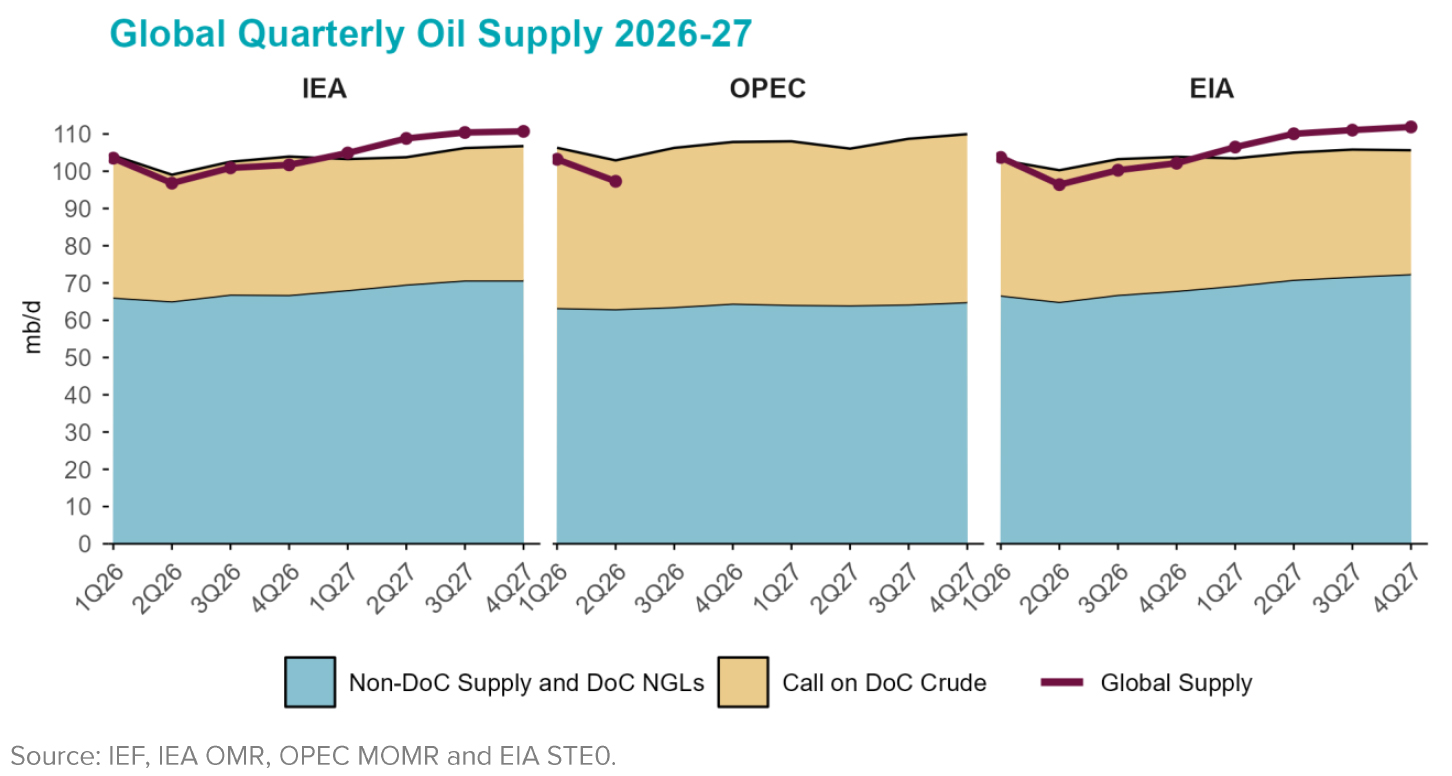
Supply projections remain relatively close throughout 2026 but separate increasingly over the forecast horizon. OPEC places non-DoC liquids supply and DoC NGL production consistently below the IEA and EIA estimates, with quarterly differences across the three outlooks of around 2.1-3.4 mb/d in 2026. The divergence becomes substantially larger in 2027 as the IEA and, particularly, the EIA assume stronger supply growth, while OPEC shows only limited expansion. The spread consequently increases from 5.2 mb/d in 1Q27 to 7.5 mb/d by 4Q27, when projections range from 64.9 mb/d under OPEC to 72.4 mb/d under the EIA. The IEA and EIA remain much more closely aligned, although their estimates also separate gradually during 2027.
2026 Outlook Comparison
The contrasting 2026 demand outlooks are driven predominantly by expectations for non-OECD economies. OPEC projects non-OECD consumption to expand by 0.5 mb/d, while the EIA and IEA anticipate declines of 1.2 mb/d and 1.9 mb/d, respectively, creating a 2.4 mb/d range across the forecasts. This difference accounts for most of the 2.9 mb/d spread in global demand growth, which ranges from a 0.4 mb/d increase under OPEC to a 2.5 mb/d contraction under the IEA. OECD projections show considerably less variation, with demand declining by 0.1 mb/d under OPEC, 0.5 mb/d under the EIA and 0.6 mb/d under the IEA.
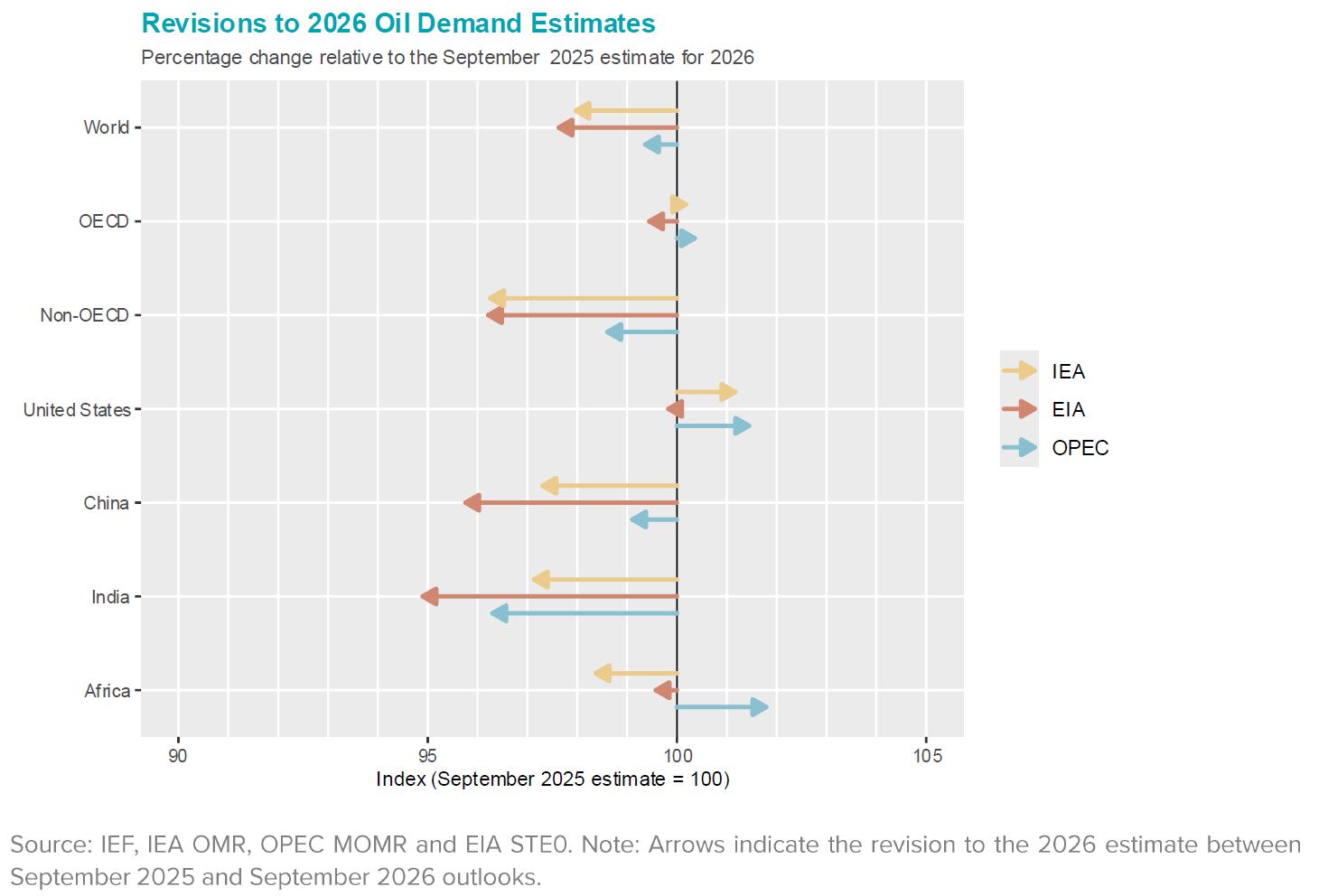
The latest revisions to the 2026 oil demand outlook remain concentrated in non-OECD economies, although the scale of adjustment varies considerably across the three outlooks. The EIA lowers its estimate by 3.8% and the IEA by 3.7%, compared with a more moderate 1.4% reduction by OPEC. Changes to OECD demand remain much smaller and move in different directions, ranging from a 0.6% downward revision by the EIA to increases of 0.4% under OPEC and 0.2% under the IEA. At the country and regional level, the picture becomes more differentiated. US demand is revised upward by OPEC (+1.5%) and the IEA (+1.2%), while the EIA makes a marginal downward revision of 0.2%. China faces broad-based downward revisions, ranging from 0.9% under OPEC to 4.2% under the EIA. India sees the largest reductions across all three outlooks, particularly from the EIA (5.1%) and OPEC (3.7%), compared with 2.9% under the IEA. Revisions for Africa also move in different directions, with OPEC raising its estimate by 1.8%, while the EIA and IEA lower their projections by 0.4% and 1.6%, respectively.
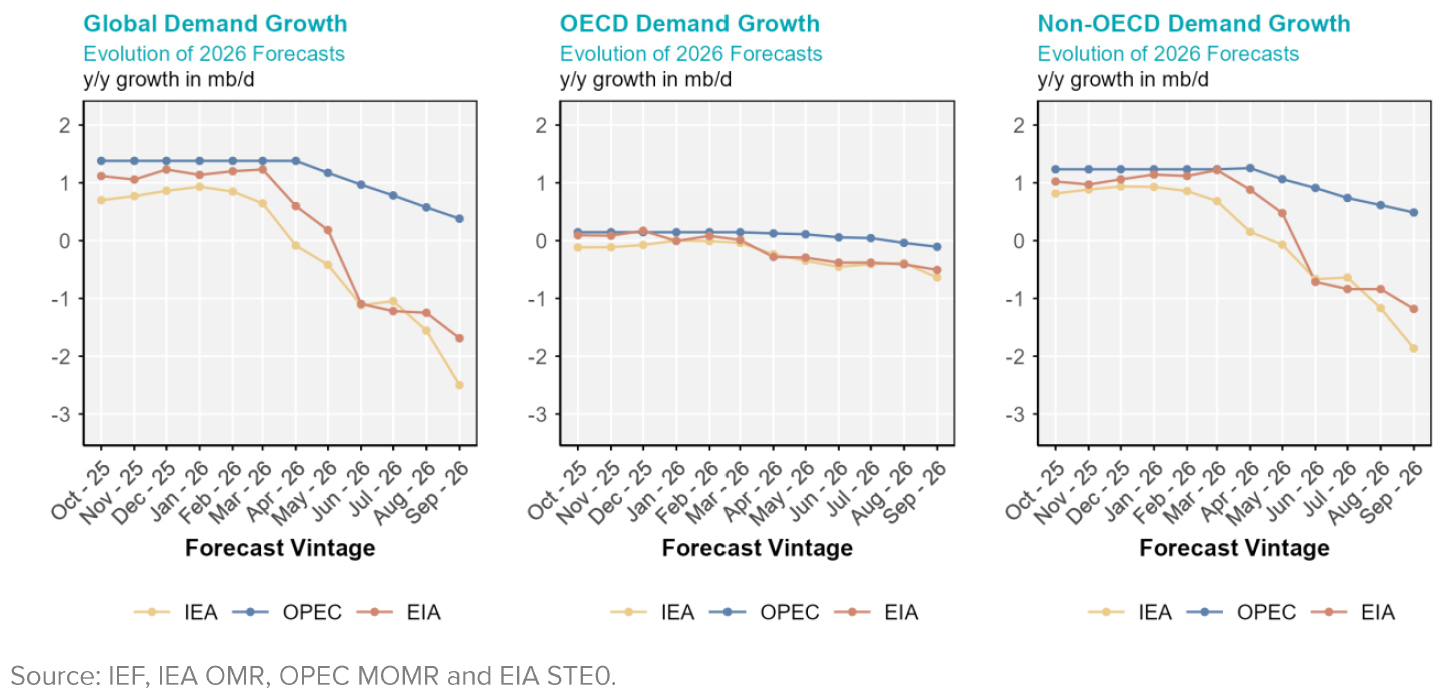
Evolution of 2026 Annual Demand Growth Forecasts
The evolution of 2026 demand forecasts show that, in January 2026, OPEC projects global demand growth of around 1.4 mb/d, compared with 0.9 mb/d from the IEA and 1.1 mb/d from the EIA. By June, the IEA and EIA have shifted to contractions of around 1.1 mb/d, while OPEC continues to expect growth of approximately 1.0 mb/d. The divergence widens further by September, with OPEC still projecting modest growth of 0.4 mb/d, compared with declines of 1.7 mb/d under the EIA and 2.5 mb/d under the IEA, resulting in a spread of approximately 2.9 mb/d.
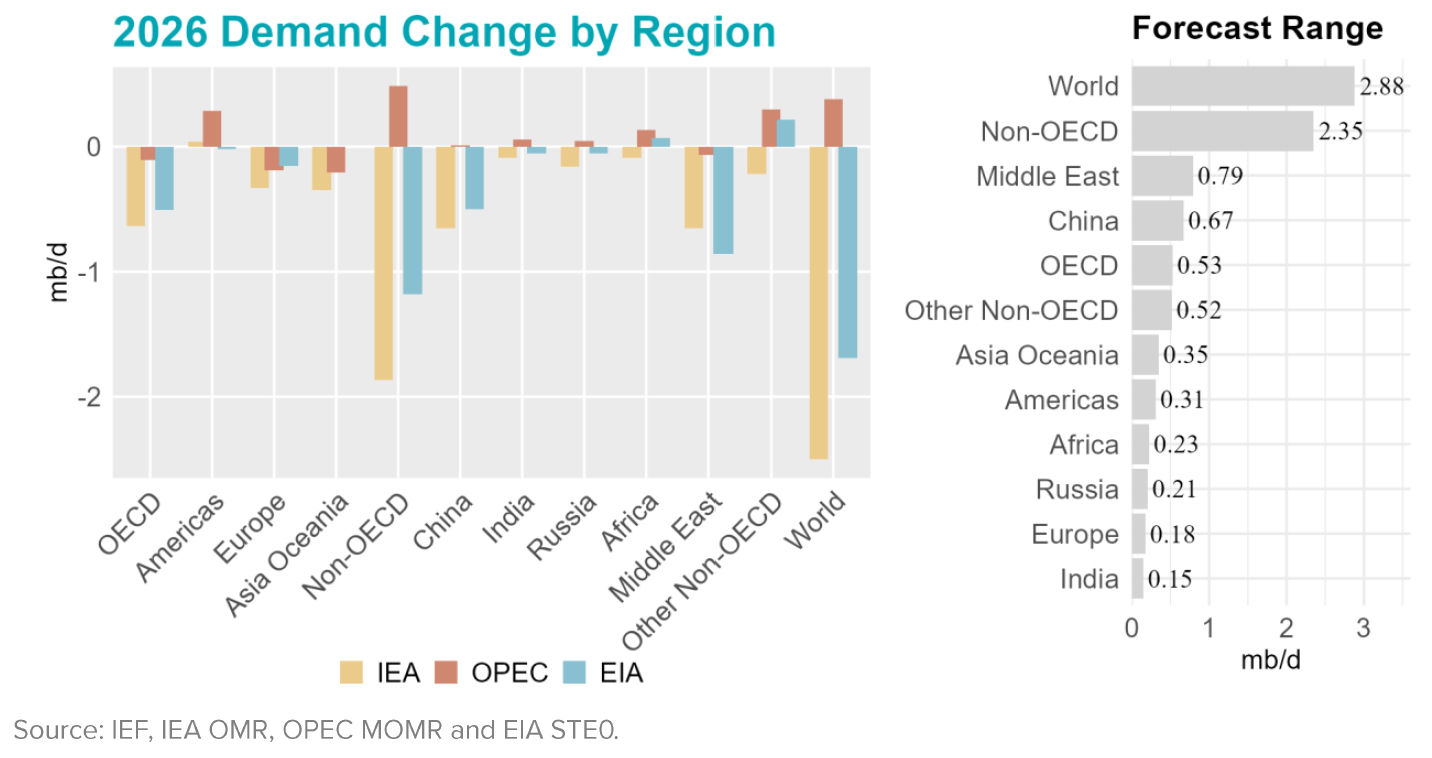
China represents an important source of the divergence across the three outlooks, with year-on-year demand falling by approximately 500 kb/d in the EIA outlook and 655 kb/d in the IEA outlook, while remaining broadly unchanged under OPEC. The forecasts also differ for India and Africa. OPEC projects positive demand growth in both markets, whereas the IEA anticipates contractions in each. The EIA presents a mixed outlook, with a modest decline in India and positive demand growth in Africa.
2027 Outlook Comparison
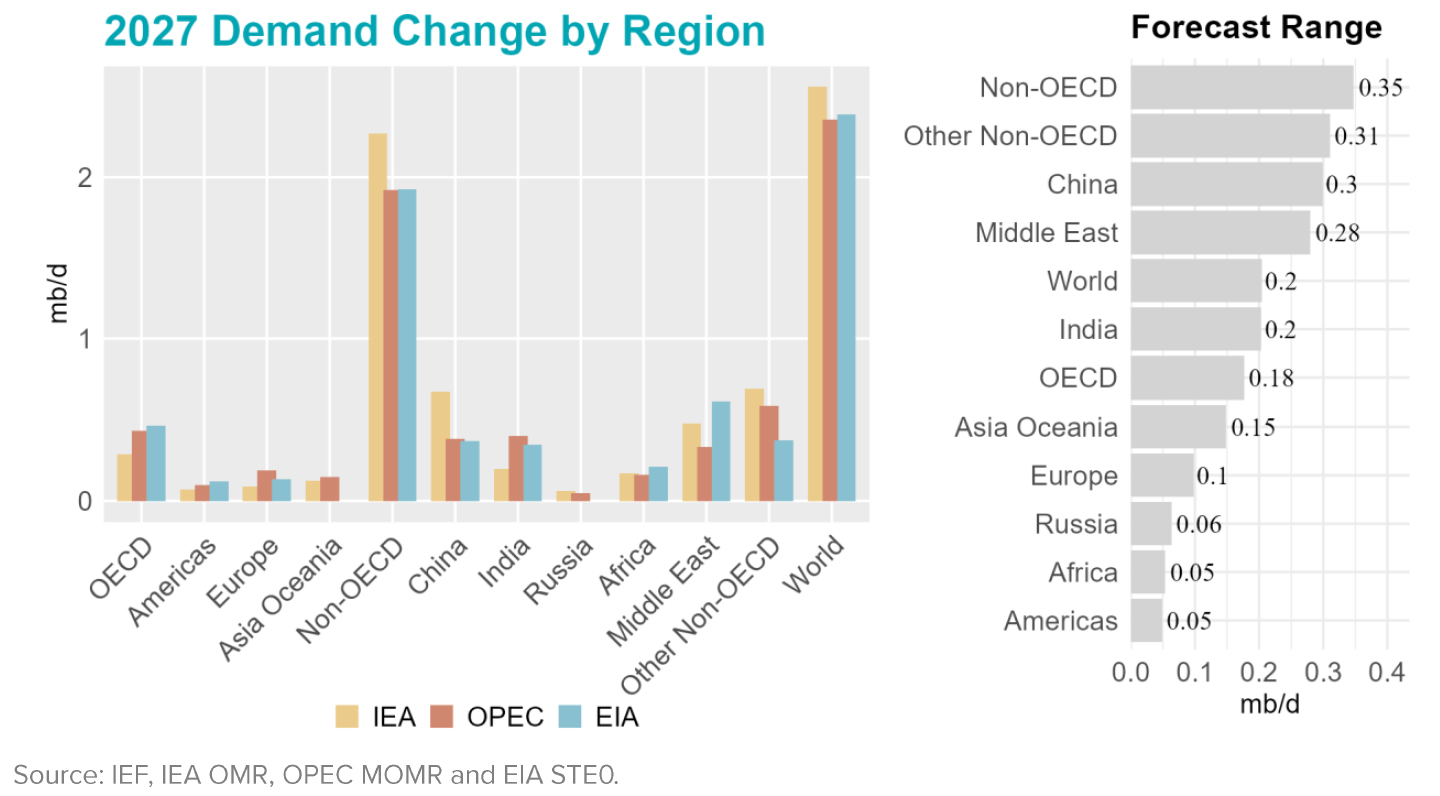
Forecasts for 2027 point to considerably greater convergence in global oil demand growth compared with the wide differences evident in 2026. OPEC and the EIA both expect demand to increase by 2.4 mb/d year-on-year, while the IEA projects slightly stronger growth of 2.6 mb/d. A similar degree of alignment is evident across OECD economies, where growth ranges from 0.3 mb/d under the IEA to 0.5 mb/d under the EIA. Non-OECD demand growth shows somewhat greater variation, with OPEC and the EIA both projecting an increase of 1.9 mb/d, compared with 2.3 mb/d under the IEA. Recent revisions to the annual demand levels, however, move in different directions. OPEC raises its 2027 estimate by 0.3 mb/d, the EIA leaves its forecast unchanged, and the IEA lowers its projection by 0.7 mb/d. Despite these changes in absolute demand levels, year-on-year growth is revised upward by 0.2 mb/d under both OPEC and the EIA and by 0.1 mb/d under the IEA.
Growth within the non-OECD region is spread across several major markets. China adds between approximately 370 and 670 kb/d, while India's contribution ranges from 200 to 400 kb/d and Africa adds around 160 to 210 kb/d. The Middle East provides a further 335 to 615 kb/d of demand growth, while the remaining non-OECD economies collectively contribute between approximately 380 and 690 kb/d.