Comparative Analysis of Monthly Reports on the Oil Market
Thursday 15 October 2026


Summary
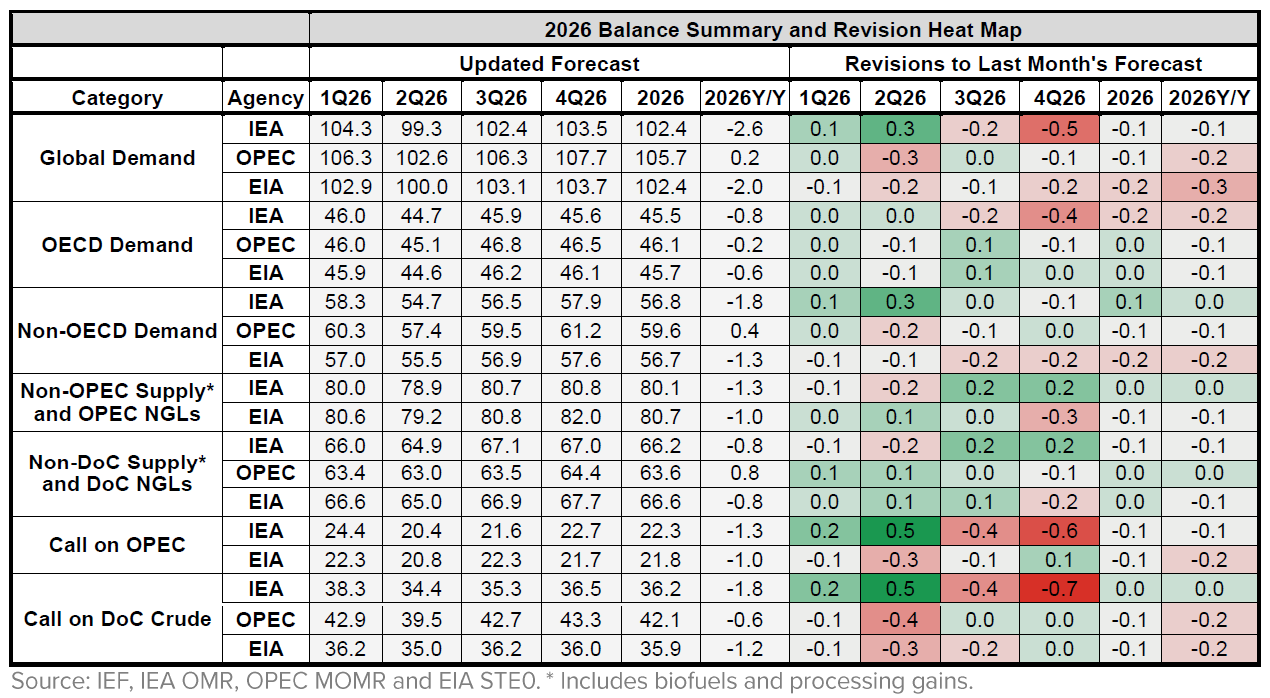
The latest forecasts reflect differing expectations for oil demand in 2026, but point to a broader recovery in 2027, driven largely by non-OECD economies. Supply growth is also expected to strengthen in 2027, although the pace varies considerably across the three outlooks.
Demand
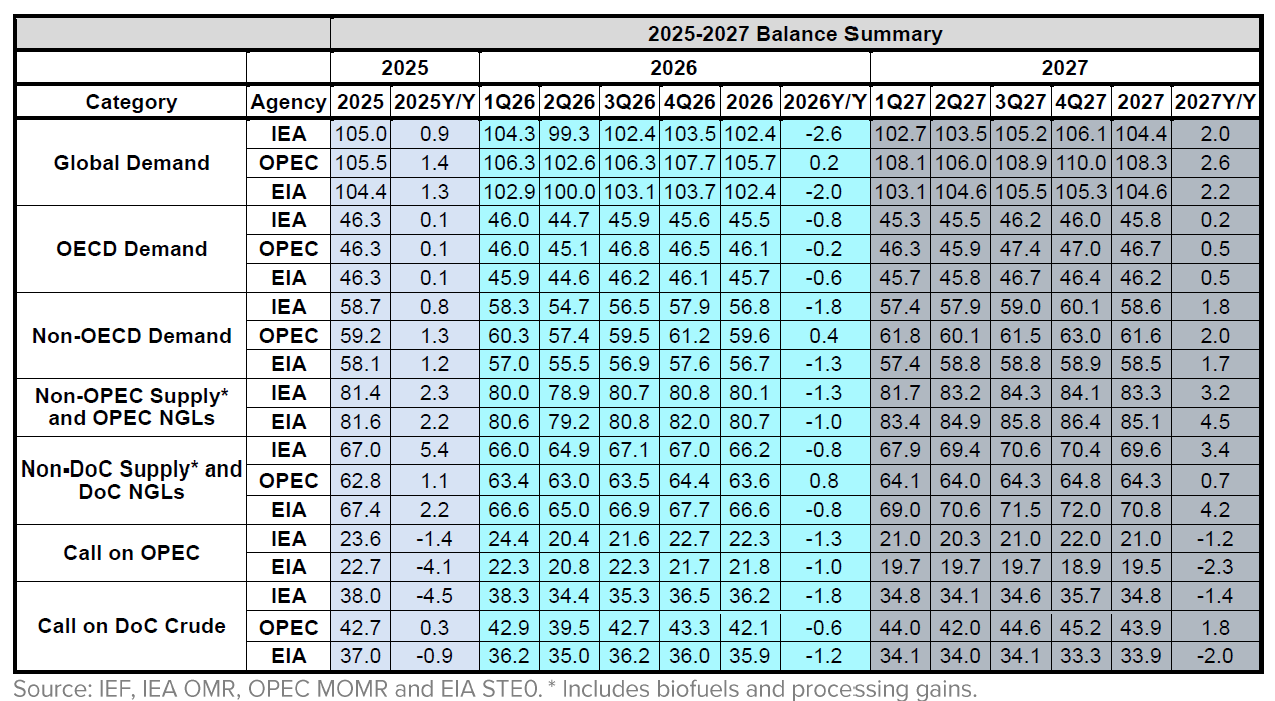
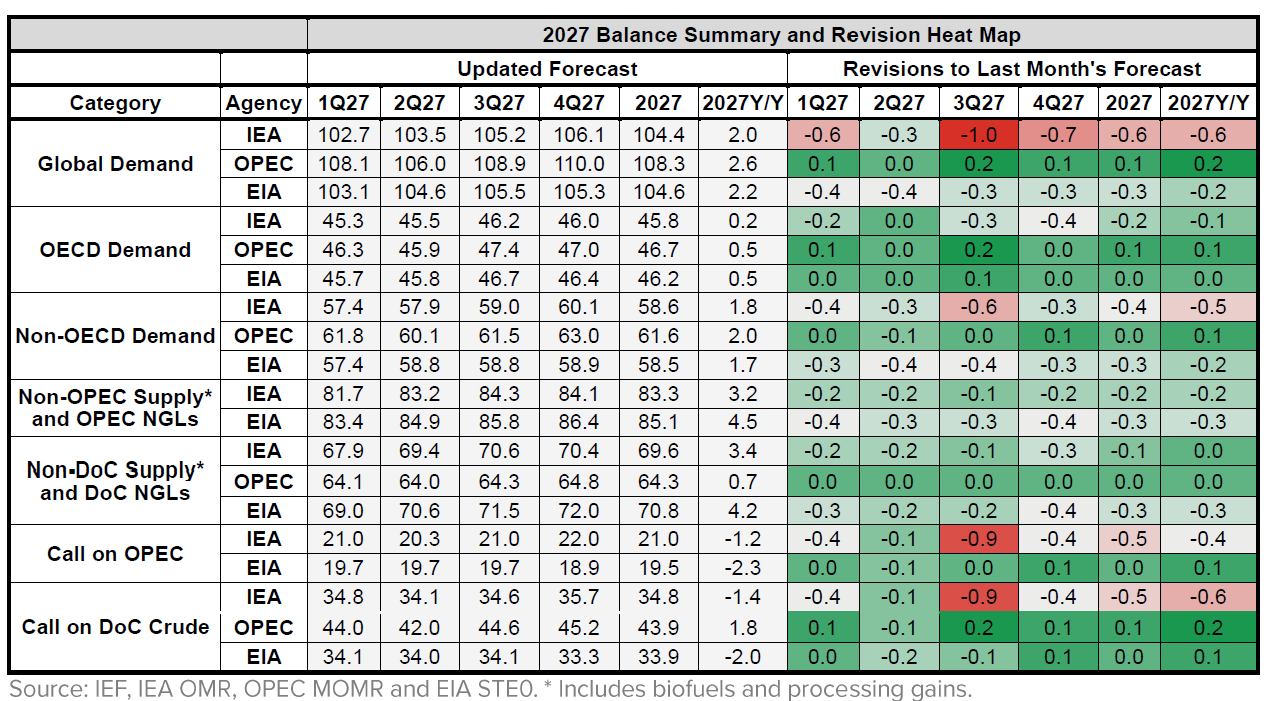
OPEC: OPEC forecasts global oil demand to average 105.7 mb/d in 2026, following a downward revision of 0.2 mb/d to its previous growth forecast. Non-OECD demand rises by 0.4 mb/d, offsetting a 0.2 mb/d decline in the OECD. Stronger growth is anticipated in 2027, with global demand reaching 108.3 mb/d, an increase of about 2.6 mb/d and an upward revision of 0.2 mb/d to the previous growth forecast. Non-OECD economies contribute 2.0 mb/d to this growth, compared with 0.5 mb/d from the OECD.
EIA: The EIA lowers its global oil demand outlook for 2026 and 2027, with consumption averaging 102.4 mb/d in 2026, a downward revision of 0.3 mb/d to its previous growth forecast. Non-OECD demand falls by 1.3 mb/d, compared with 0.6 mb/d in the OECD. In 2027, global demand recovers to 104.6 mb/d, an increase of 2.2 mb/d and a downward revision of 0.2 mb/d to the previous growth forecast. Non-OECD economies account for 1.7 mb/d of this growth, compared with 0.5 mb/d in the OECD.
IEA: The IEA lowers its global oil demand outlook for 2026 and 2027, projecting demand to average 102.4 mb/d in 2026, a decline of 2.6 mb/d year-on-year, with its previous growth forecast revised downward by 0.1 mb/d. Non-OECD demand falls by 1.8 mb/d, compared with 0.8 mb/d in the OECD. In 2027, global demand recovers by 2.0 mb/d to 104.4 mb/d, although the growth forecast is revised downward by 0.6 mb/d. Non-OECD economies account for 1.8 mb/d of this growth, compared with 0.2 mb/d in the OECD.
Supply
OPEC: OPEC projects combined non-DoC liquids supply and DoC NGL production to reach 63.6 mb/d in 2026, an increase of 0.8 mb/d, driven mainly by the United States, Brazil, Argentina and Canada. In 2027, output rises by a further 0.7 mb/d to 64.3 mb/d, with Qatar, Argentina, Canada, and Brazil leading the growth. OPEC keeps its supply growth forecasts for both years unchanged from the previous month.
EIA: The EIA forecasts combined non-DoC liquids supply and DoC NGL production to average 66.6 mb/d in 2026, a decline of 0.8 mb/d year-on-year. In 2027, annual production rises by 4.2 mb/d to 70.8 mb/d, with quarterly output increasing from 69.0 mb/d in the first quarter to 72.0 mb/d in the fourth quarter. The EIA keeps its 2026 supply forecast unchanged while revising its 2027 projection downward by 0.3 mb/d.
IEA: The IEA lowers its combined non-DoC liquids supply and DoC NGL production forecast for 2026 by 0.1 mb/d to 66.2 mb/d, a decline of 0.8 mb/d year-on-year. In 2027, annual production rises by 3.4 mb/d to 69.6 mb/d, with quarterly output increasing from 67.9 mb/d in the first quarter to a peak of 70.6 mb/d in the th ird quarter, before easing to 70.4 mb/d in the fourth quarter.
2025-2027 Balance Summary
The latest forecasts show considerable differences in global oil demand expectations for 2026. OPEC anticipates a modest increase of 0.2 mb/d to 105.7 mb/d, while the EIA and IEA project declines of 2.0 mb/d and 2.6 mb/d, respectively, with both placing demand at 102.4 mb/d. The gap between the highest and lowest estimates stands at 3.3 mb/d. For 2027, all three agencies expect demand to recover, with growth forecasts ranging from 2.0 to 2.6 mb/d. However, differences in absolute demand levels persist, with projections ranging from 104.4 mb/d to 108.3 mb/d.
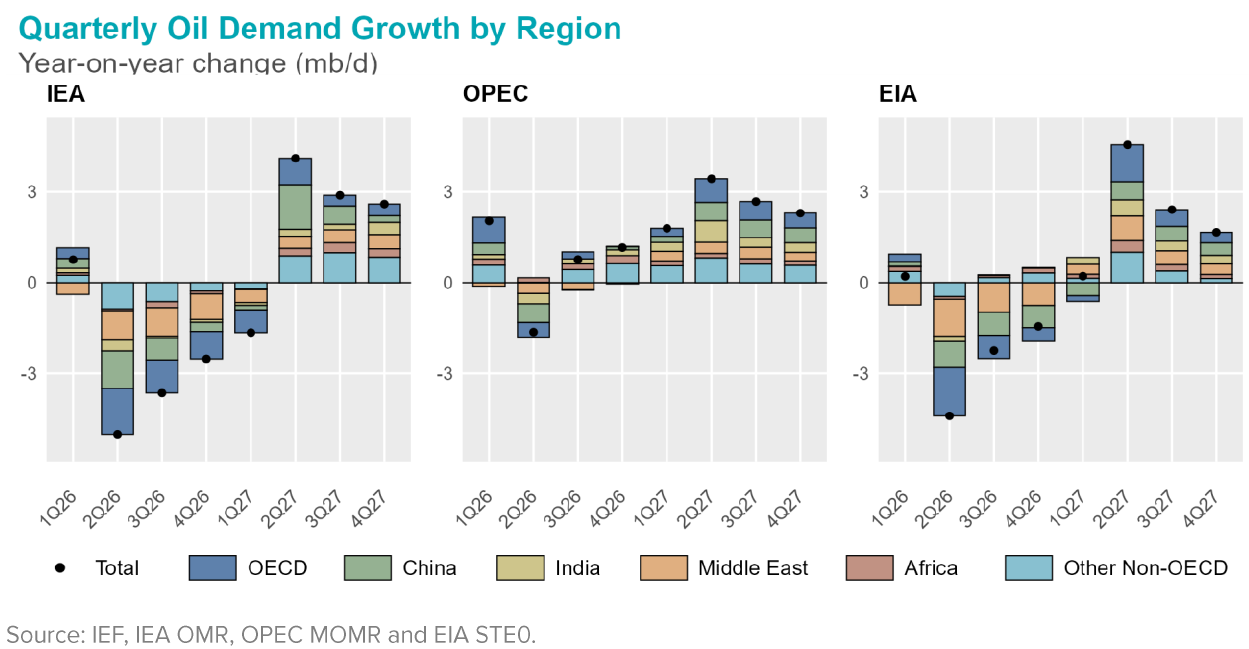
Quarterly oil demand growth forecasts reveal substantial differences across the three agencies in 2026, particularly in the second quarter, when the IEA and EIA project contractions of 5.0 mb/d and 4.4 mb/d, respectively, compared with 1.6 mb/d for OPEC. Weakness in OECD economies, China and the Middle East accounts for much of the projected decline. In 2027, all three outlooks anticipate a recovery, with the strongest growth concentrated in the second quarter, although regional contributions differ, particularly across China, India, and the OECD.
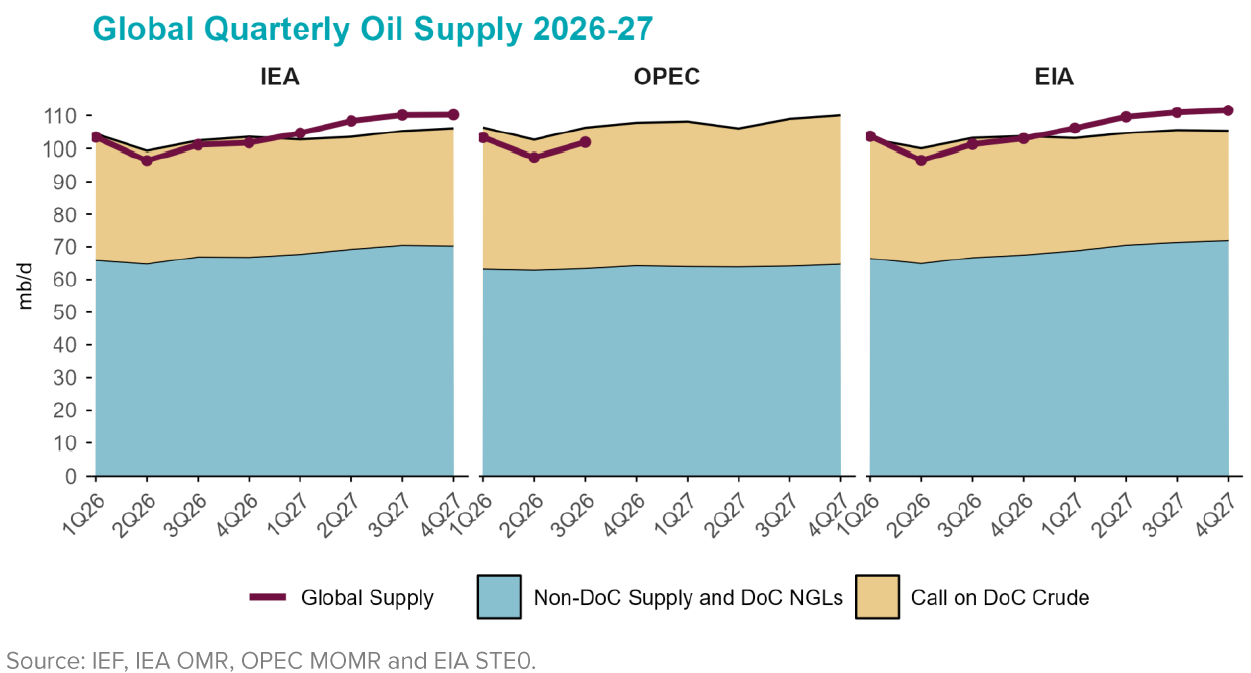
The three outlooks indicate different trajectories for non-DoC liquids supply and DoC NGL production. In 2026, the IEA and EIA project broadly similar quarterly volumes, while OPEC maintains lower estimates. These differences widen in 2027, as the IEA and EIA anticipate stronger production growth compared with OPEC's more modest expansion. By the fourth quarter, supply estimates range from 64.8 mb/d under OPEC to 72.0 mb/d under the EIA, a gap of 7.2 mb/d. This divergence is also reflected in the call on DoC crude, with OPEC projecting 45.2 mb/d compared with 35.7 mb/d and 33.3 mb/d under the IEA and EIA, respectively.
2026 Outlook Comparison
Differences in non-OECD demand expectations remain the main source of divergence across the 2026 outlooks. OPEC forecasts growth of 0.4 mb/d, compared with contractions of 1.3 mb/d under the EIA and 1.8 mb/d under the IEA. OECD demand is expected to decline across all three forecasts, although within a narrower range of 0.2 to 0.8 mb/d. The latest monthly revisions also point to slightly weaker global demand expectations, with all three agencies lowering their 2026 projections by 0.1 to 0.3 mb/d.
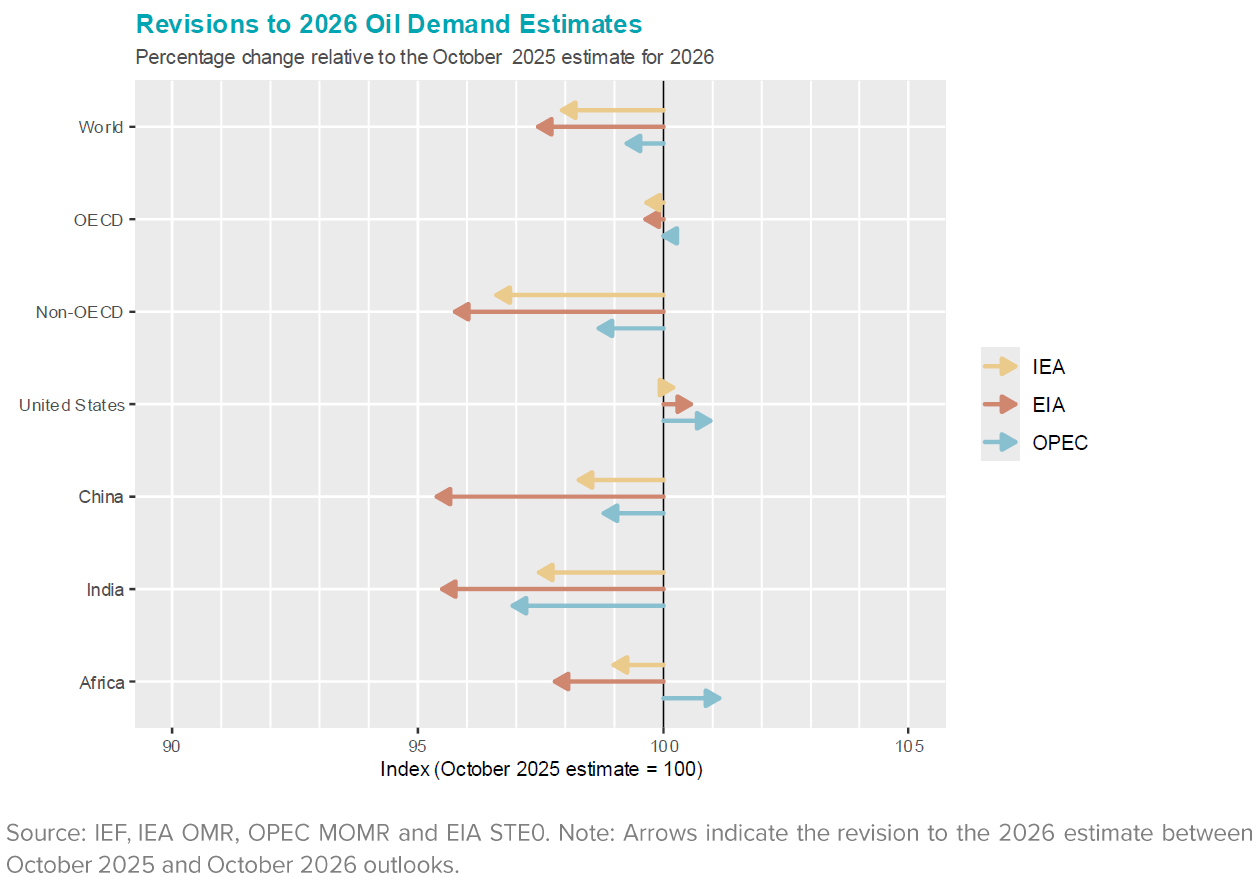
The latest adjustments to 2026 oil demand forecasts are more pronounced in non-OECD economies, with the EIA recording the largest reduction at 4.2%, followed by the IEA at 3.4% and OPEC at 1.3%. China and India account for much of the downward adjustment, particularly in the EIA outlook, where demand estimates fall by 4.6% and 4.5%, respectively. In contrast, OECD revisions remain relatively limited, while US demand estimates increase across all three outlooks. Africa presents a mixed picture, with OPEC revising demand upward by 1.1%, compared with reductions of 2.2% by the EIA and 1.0% by the IEA.
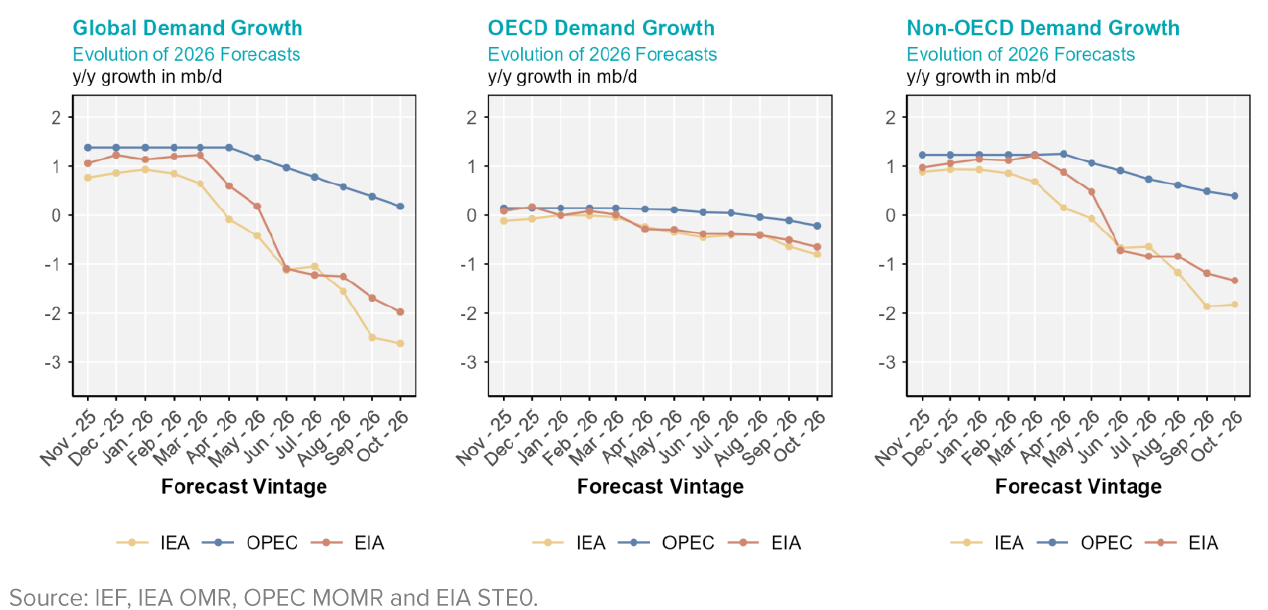
Evolution of 2026 Annual Demand Growth Forecasts
The 2026 oil demand outlook has evolved from relatively aligned growth expectations at the start of the year to considerably different assessments by October. In January, all three agencies anticipated growth of around 0.9 to 1.4 mb/d. The IEA turned to a contraction in April, followed by the EIA in June, while OPEC continued to project growth. By October, OPEC's forecast had moderated to 0.2 mb/d, compared with declines of 2.0 mb/d under the EIA and 2.6 mb/d under the IEA. Much of this adjustment reflects weaker expectations for non-OECD demand, although OECD projections have also been revised downward.
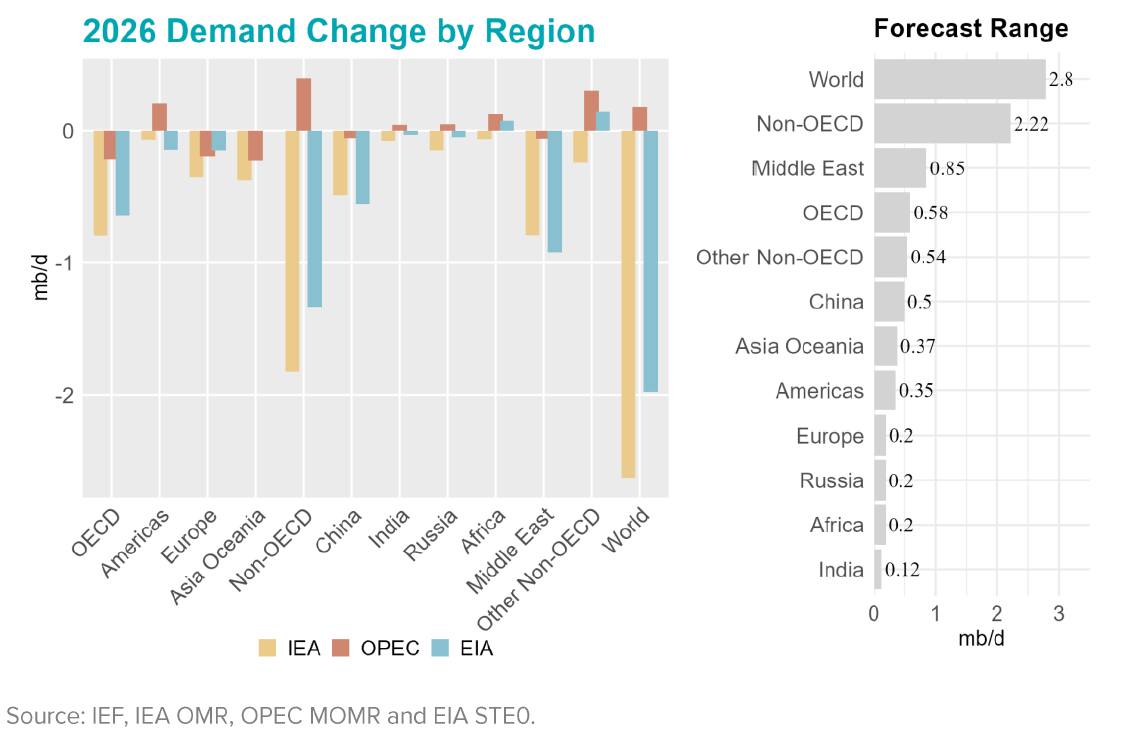
Regional demand projections for 2026 highlight differences in the expected contributions of major consumer markets. China is projected to record demand declines of 0.56 mb/d by the EIA and 0.49 mb/d by the IEA, compared with a smaller reduction of 0.06 mb/d under OPEC. The Middle East also accounts for a significant share of the projected contraction, particularly in the EIA and IEA projections, at 0.92 mb/d and 0.79 mb/d, respectively. For India and Africa, OPEC anticipates modest demand growth, while the IEA projects decline in both markets. The EIA expects a slight contraction in India alongside growth in Africa.
2027 Outlook Comparison
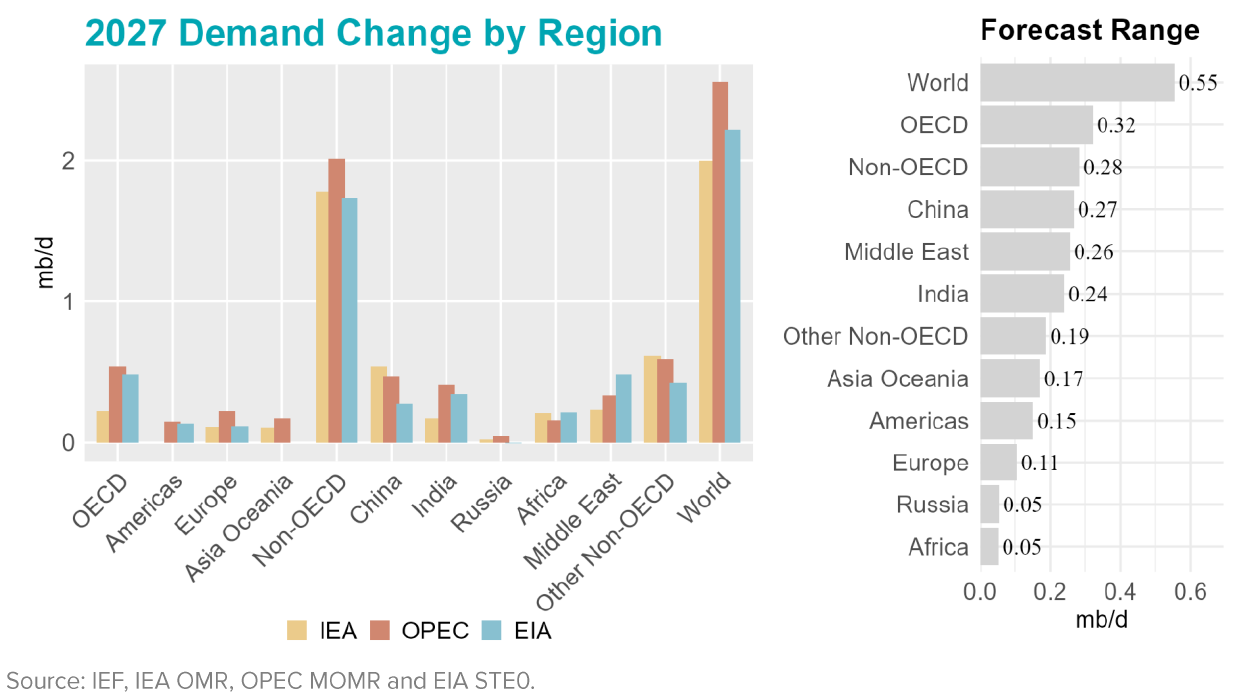
Global oil demand growth expectations for 2027 show greater alignment across the three agencies, with projections ranging from 2.0 mb/d under the IEA to 2.6 mb/d under OPEC. Non-OECD economies account for most of the anticipated increase, contributing between 1.7 and 2.0 mb/d, while OECD demand growth remains relatively modest at 0.2 to 0.5 mb/d. Despite this broad agreement on growth, annual demand estimates remain separate, ranging from 104.4 mb/d under the IEA to 108.3 mb/d under OPEC. The latest revisions also differ, with OPEC raising its annual forecast by 0.1 mb/d, compared with reductions of 0.3 mb/d by the EIA and 0.6 mb/d by the IEA.
China is projected to contribute between 0.27 and 0.54 mb/d, while India's contribution ranges from 0.17 to 0.41 mb/d. The Middle East is also expected to support demand growth, adding between 0.23 and 0.49 mb/d, alongside a relatively consistent contribution from Africa of 0.16 to 0.21 mb/d. Other non-OECD economies collectively account for a further 0.42 to 0.61 mb/d.