Comparative Analysis of Monthly Reports on the Oil Market
Thursday 15 November 2026


Summary
Oil market projections present contrasting trajectories for 2026 and 2027. While OPEC maintains a relatively resilient demand outlook, the IEA and EIA envisage a sharp contraction in 2026, followed by a recovery across all three forecasts in 2027. Differences extend to the supply outlook, where the IEA and EIA anticipate a substantial expansion in 2027. These contrasting projections underscore considerable uncertainty over the evolution of global oil market fundamentals.
Demand
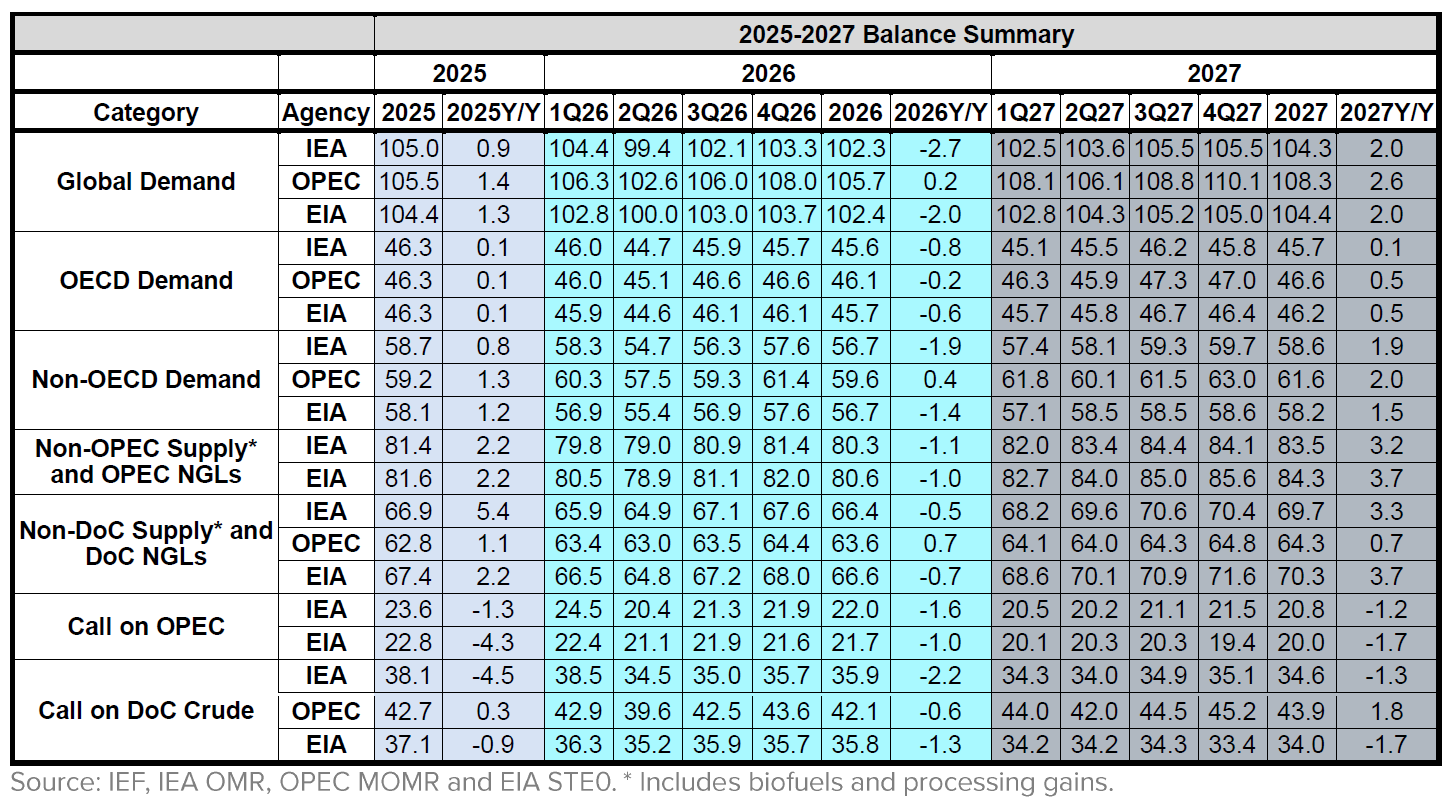
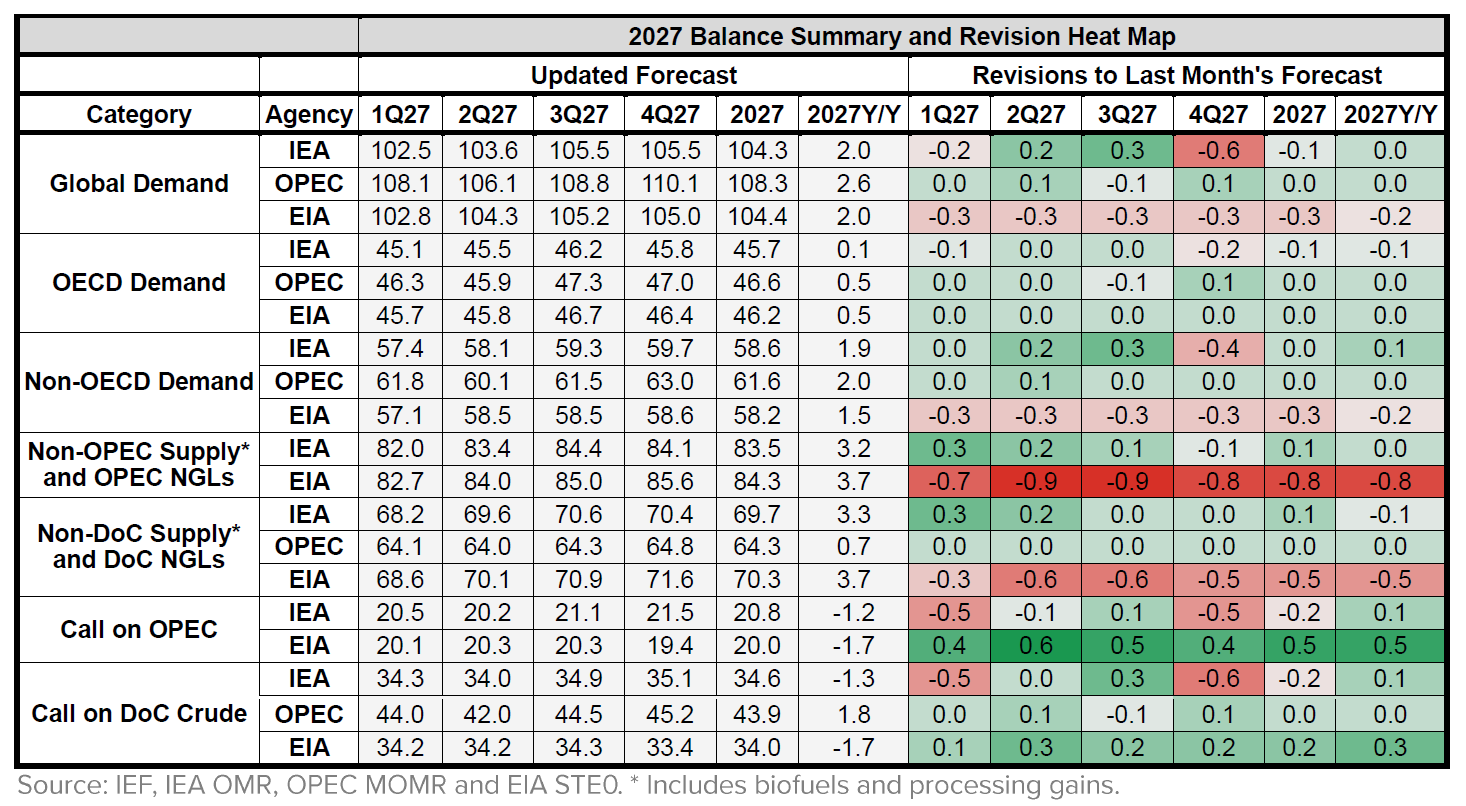
OPEC: OPEC expects global oil demand to remain broadly stable in 2026 at 105.7 mb/d, with an increase of 0.2 mb/d as continued consumption gains in non-OECD economies are largely offset by weaker OECD demand. The outlook strengthens considerably in 2027, when global demand is projected to reach 108.3 mb/d, adding 2.6 mb/d year-on-year. This acceleration is primarily supported by non-OECD economies, which contribute 2.0 mb/d of additional demand, alongside a recovery of 0.5 mb/d in OECD consumption.
EIA: The EIA anticipates a contraction in global oil demand in 2026, with consumption averaging 102.4 mb/d, a decline of 2.0 mb/d from 2025. The decrease is concentrated in non-OECD economies, where demand falls by 1.4 mb/d, compared with a 0.6 mb/d reduction in the OECD. Demand is expected to rebound in 2027, reaching 104.4 mb/d, an increase of 2.0 mb/d year-on-year. Non-OECD economies drive most of this recovery, contributing 1.5 mb/d of additional demand, while OECD consumption rises by 0.5 mb/d.
IEA: The IEA projects global oil demand to contract by 2.7 mb/d in 2026, bringing total consumption to 102.3 mb/d. The decline is largely driven by non-OECD economies, where demand falls by 1.9 mb/d, compared with a 0.8 mb/d reduction in the OECD. A recovery is anticipated in 2027, with global demand rising by 2.0 mb/d to 104.3 mb/d. Non-OECD economies lead this rebound, adding 1.9 mb/d, while OECD demand remains relatively stable, increasing by just 0.1 mb/d.
Supply
OPEC: OPEC projects combined non-DoC liquids supply and DoC NGL production to rise by 0.7 mb/d in 2026, reaching 63.6 mb/d, with the United States, Brazil, Argentina and Canada accounting for most of the growth. In 2027, supply increases by a further 0.7 mb/d to 64.3 mb/d, with Qatar, Argentina, Canada, and Brazil contributing the largest gains.
EIA: The EIA forecasts combined non-DoC liquids supply and DoC NGL production to decline by 0.7 mb/d in 2026, averaging 66.6 mb/d. Supply rebounds strongly in 2027, increasing by 3.7 mb/d to 70.3 mb/d, with quarterly production rising steadily from 68.6 mb/d in the first quarter to 71.6 mb/d in the fourth quarter.
IEA: The IEA expects combined non-DoC liquids supply and DoC NGL production to decline by 0.5 mb/d in 2026, averaging 66.4 mb/d. Supply recovers strongly in 2027, increasing by 3.3 mb/d to 69.7 mb/d, with quarterly output rising from 68.2 mb/d in the first quarter to a peak of 70.6 mb/d in the third quarter, before easing slightly to 70.4 mb/d in the fourth quarter.
2025-2027 Balance Summary
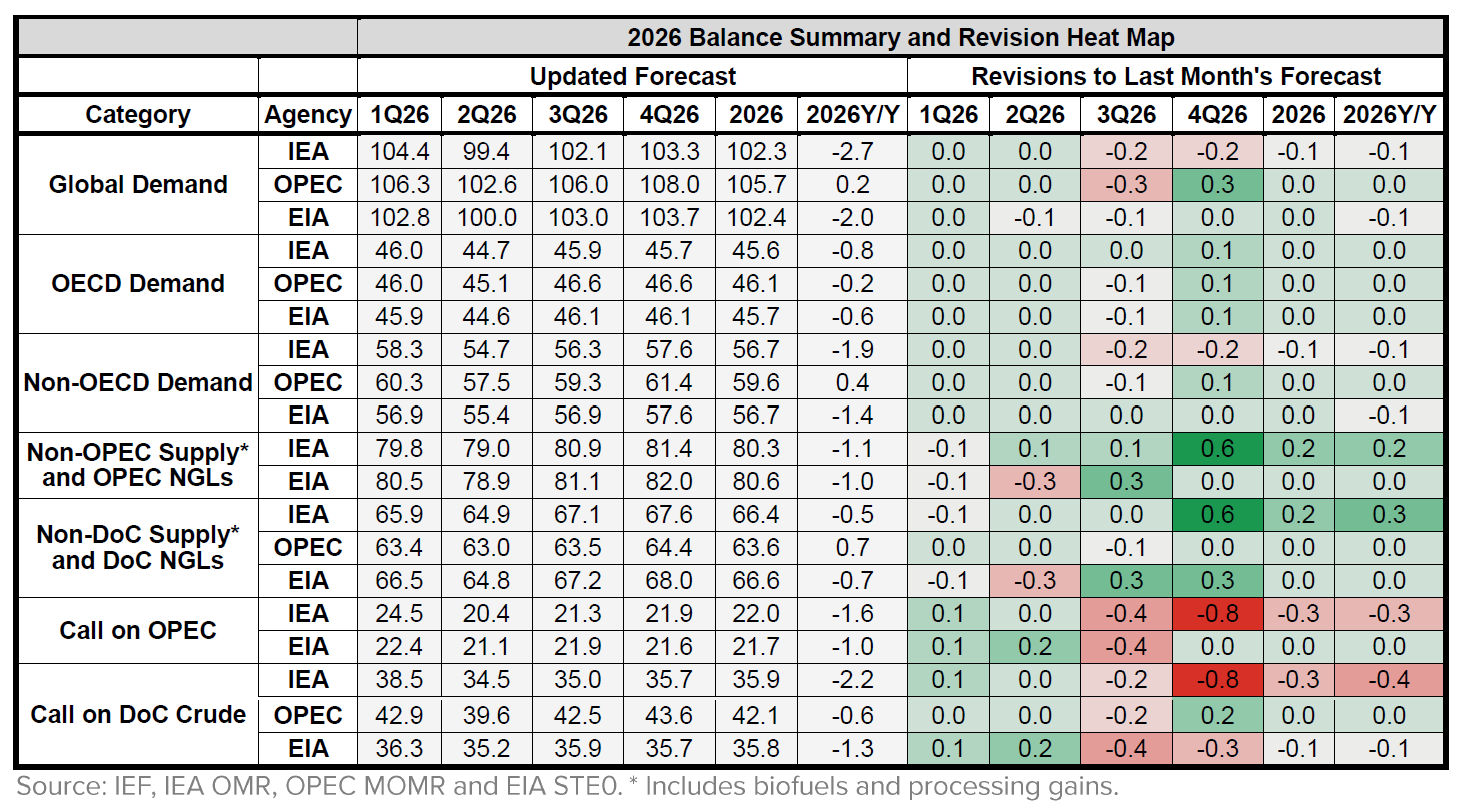
Global oil demand outlooks diverge sharply in 2026, with OPEC maintaining a relatively stable consumption trajectory at 105.7 mb/d, up 0.2 mb/d from 2025. In contrast, the EIA and IEA foresee contractions of 2.0 mb/d and 2.7 mb/d, bringing demand to 102.4 mb/d and 102.3 mb/d, respectively. This places the spread between the highest and lowest estimates at 3.4 mb/d. Despite a shared expectation of renewed demand growth in 2027, ranging from 2.0 to 2.6 mb/d, the disparity in projected consumption levels widens to 4.0 mb/d, with OPEC forecasting 108.3 mb/d against 104.4 mb/d from the EIA and 104.3 mb/d from the IEA.
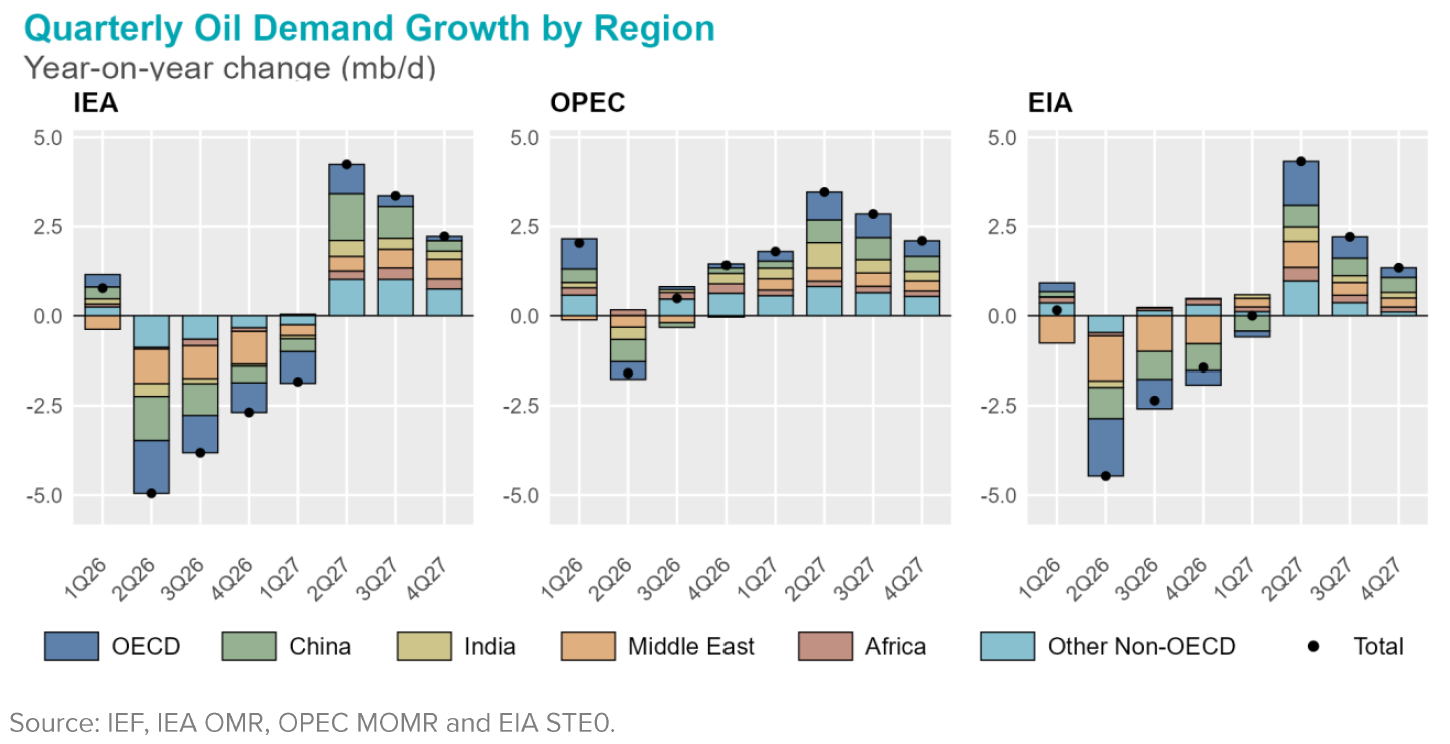
Quarterly oil demand projections highlight a sharp contraction in the second quarter of 2026, with declines reaching 5.0 mb/d under the IEA outlook and 4.5 mb/d under the EIA, compared with 1.6 mb/d for OPEC. The downturn reflects widespread weakness across OECD economies, China, and the Middle East, although its magnitude varies considerably between outlooks. By 2027, demand growth turns positive across most quarters, with the strongest gains emerging in the second quarter, ranging from 3.5 mb/d under OPEC to 4.3 mb/d under the EIA and 4.2 mb/d under the IEA. China accounts for a particularly large share of the IEA's projected increase, while OECD economies and the Middle East contribute more prominently under the EIA outlook.
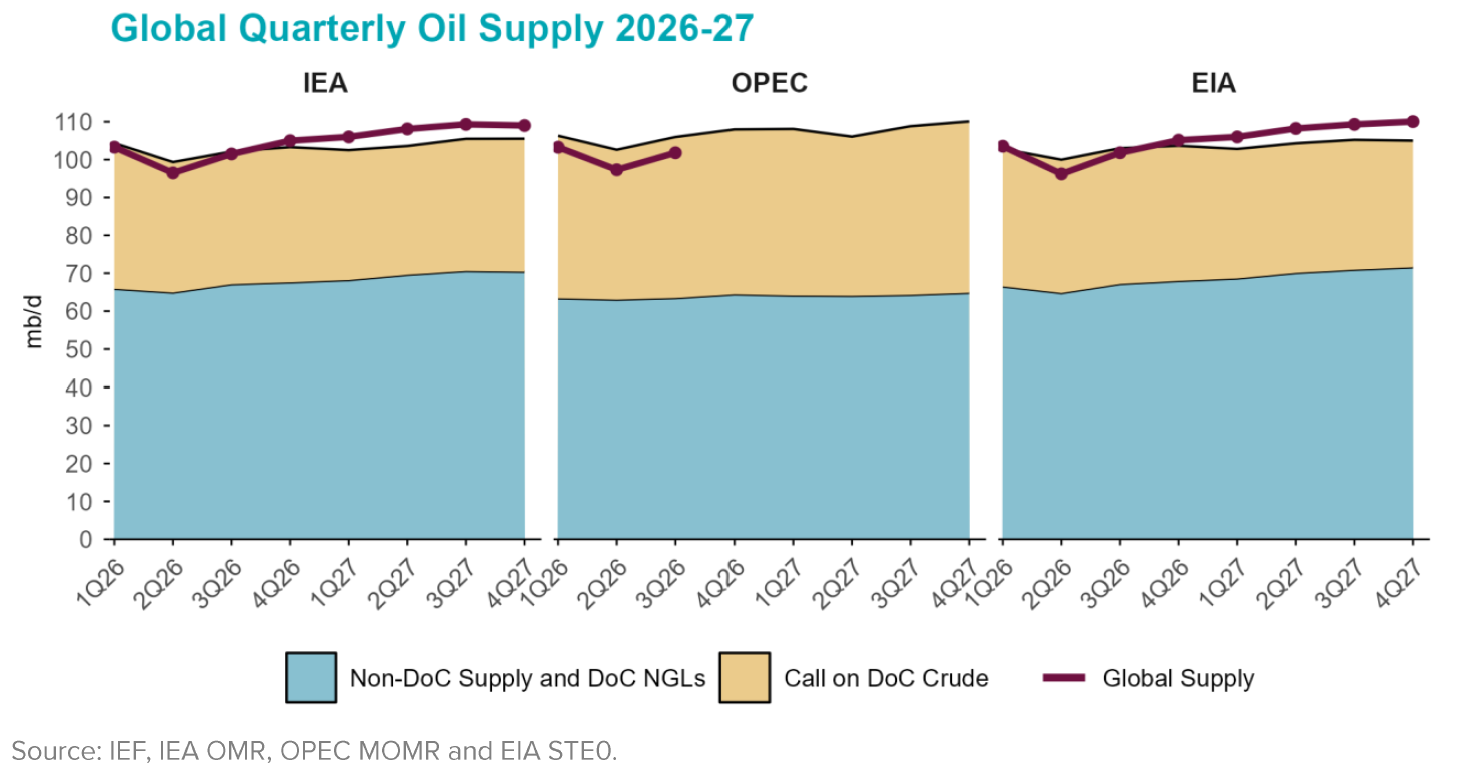
Global liquids supply estimates remain broadly aligned across the three outlooks during the first three quarters of 2026, with the largest difference emerging in the second quarter, when OPEC places output at 97.3 mb/d, compared with 96.5 mb/d under the IEA and 96.2 mb/d under the EIA. Beyond this period, the IEA and EIA anticipate a steady expansion in global supply, reaching approximately 109 mb/d and 110 mb/d, respectively, by the fourth quarter of 2027. Underlying supply projections reveal considerably wider differences, particularly for non-DoC liquids and DoC NGLs, where fourth-quarter 2027 estimates range from 64.8 mb/d under OPEC to 71.6 mb/d under the EIA, while the call on DoC crude varies from 33.4 mb/d under the EIA to 45.2 mb/d under OPEC.
2026 Outlook Comparison
Non-OECD economies account for most of the variation in global oil demand projections for 2026, with OPEC anticipating growth of 0.4 mb/d, against declines of 1.4 mb/d under the EIA and 1.9 mb/d under the IEA. OECD consumption follows a more consistent downward trend across the three outlooks, with reductions ranging from 0.2 to 0.8 mb/d. Monthly revisions remain relatively limited, with the IEA lowering its global demand estimate by 0.1 mb/d, while OPEC and the EIA maintain their annual projections unchanged.
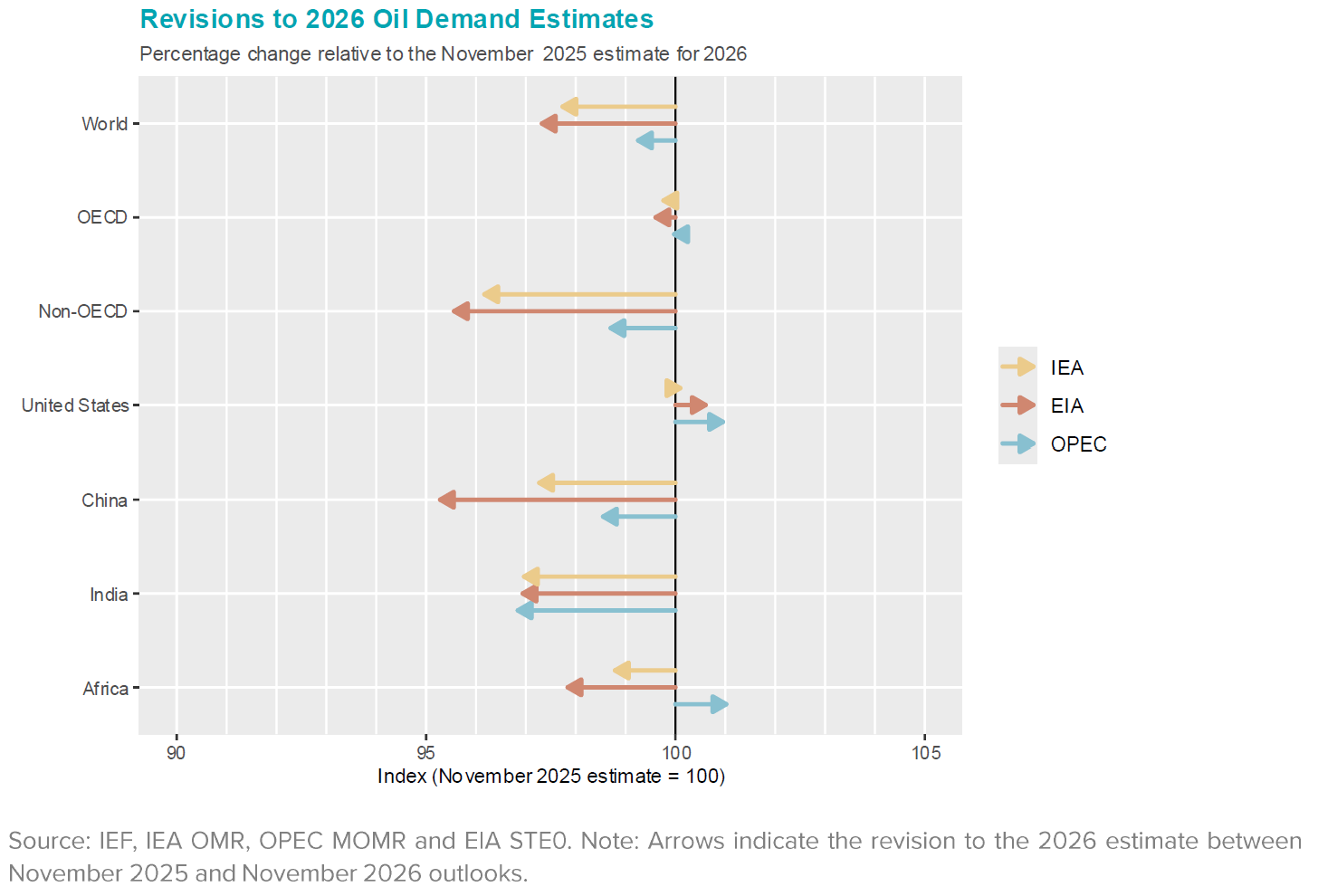
Revisions to the 2026 oil demand outlooks are concentrated in non-OECD economies, with reductions of 4.4% under the EIA, 3.8% under the IEA and 1.3% under OPEC, compared with declines of less than 0.4% across OECD economies. China records the largest downward adjustment among the major markets, particularly under the EIA outlook at 4.7%, while India's demand estimates fall by approximately 3% across all three outlooks. The United States remains an exception, with upward revisions ranging from 0.1% to 1.0%. Africa shows contrasting expectations, as OPEC raises its estimate by 1.0%, against reductions of 2.2% under the EIA and 1.2% under the IEA.
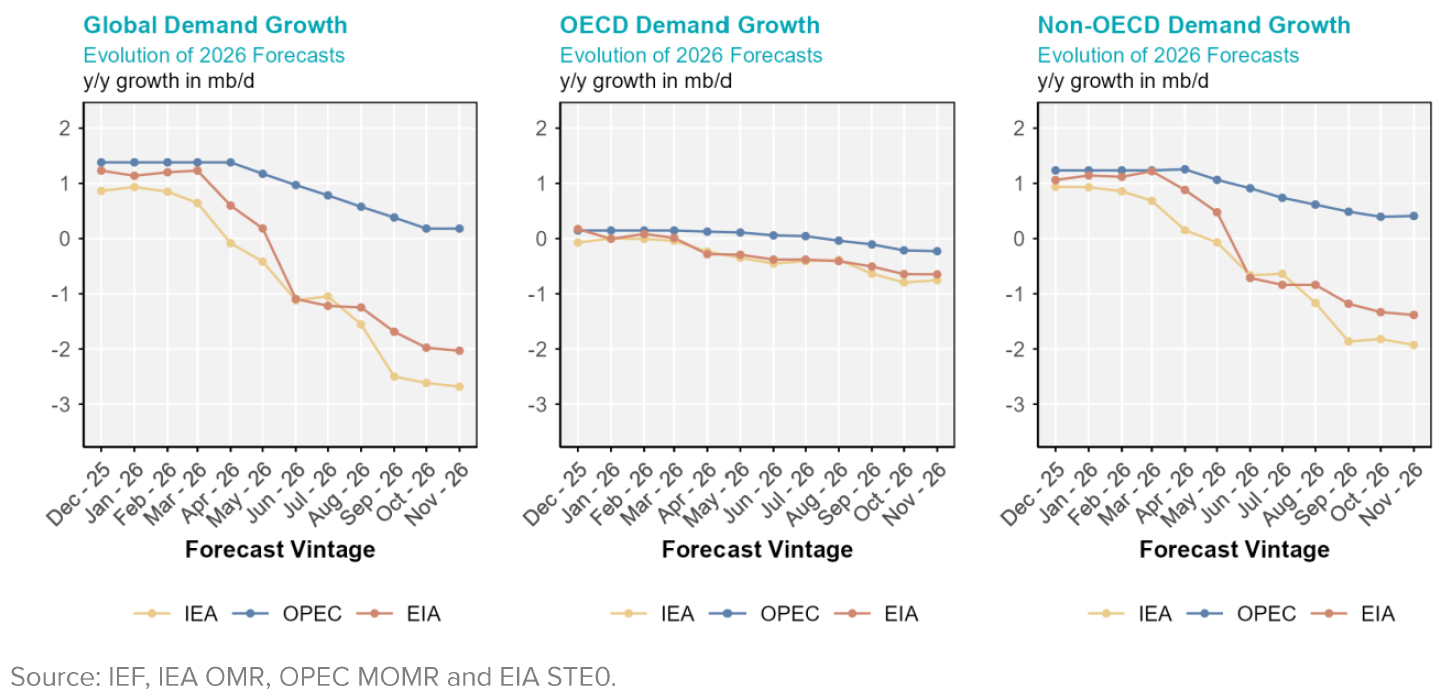
Evolution of 2026 Annual Demand Growth Forecasts
Successive revisions throughout 2026 have shifted global oil demand expectations from growth to contraction, widening the gap between the three outlooks. Starting the year with projected increases of 0.9 to 1.4 mb/d, the IEA moves into negative territory in April, followed by the EIA in June, while OPEC maintains positive growth estimates. By November, the IEA anticipates a decline of 2.7 mb/d, compared with 2.0 mb/d under the EIA, whereas OPEC continues to forecast a modest increase of 0.2 mb/d. The downward revisions are largely driven by non-OECD economies, with OECD demand also shifting towards contraction across all three outlooks.
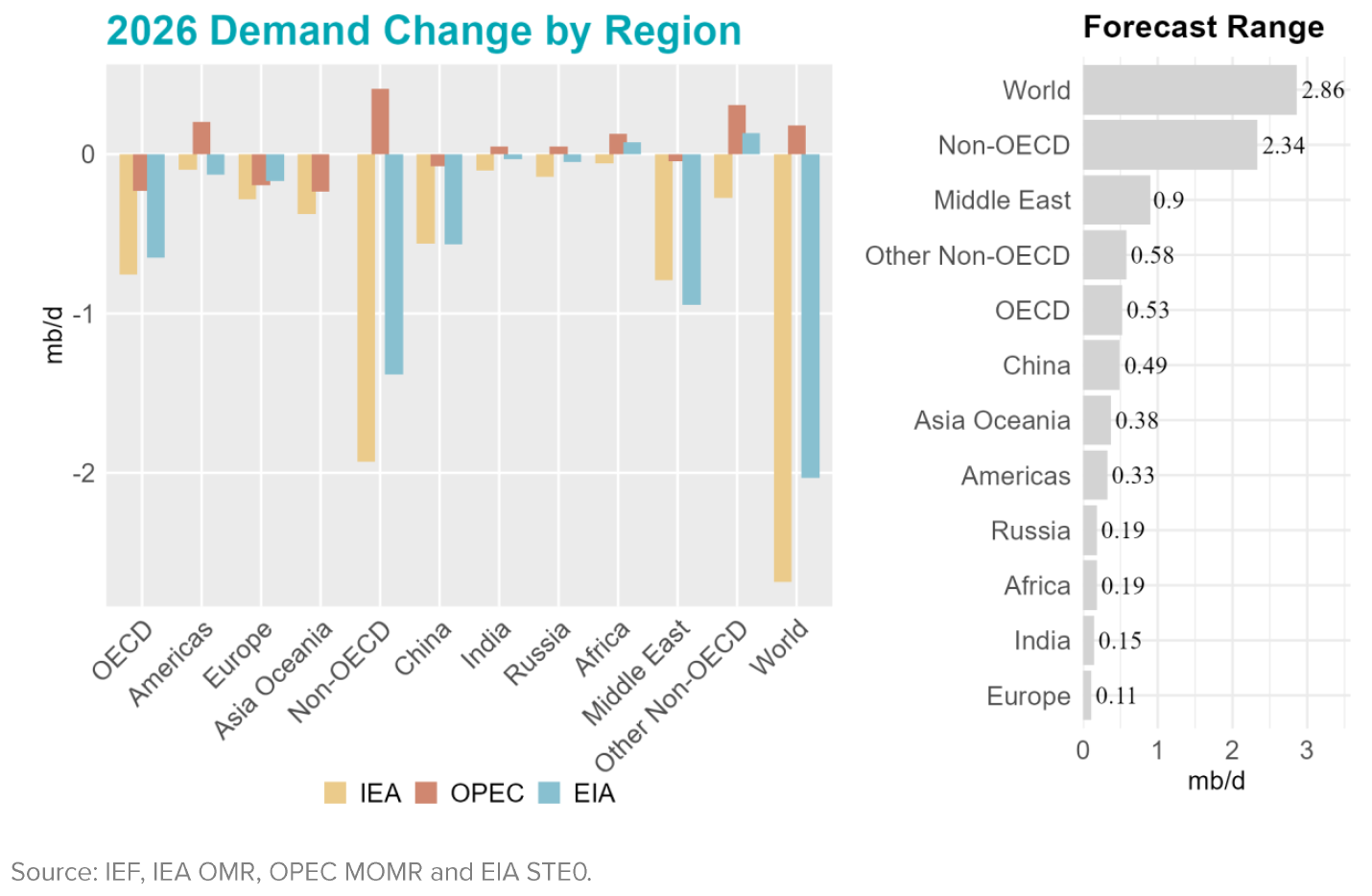
Regional demand outlooks for 2026 identify non-OECD economies as the main contributors to the anticipated contraction in global consumption. The EIA projects decline of 0.57 mb/d in China, closely aligned with the IEA estimates of 0.56 mb/d while OPEC anticipates considerably smaller reduction at less than 0.1 mb/d. Across OECD economies, the IEA and EIA forecast declines of 0.76 mb/d and 0.65 mb/d, respectively, compared with 0.23 mb/d under OPEC, further contributing to the differences in global demand expectations.
2027 Outlook Comparison
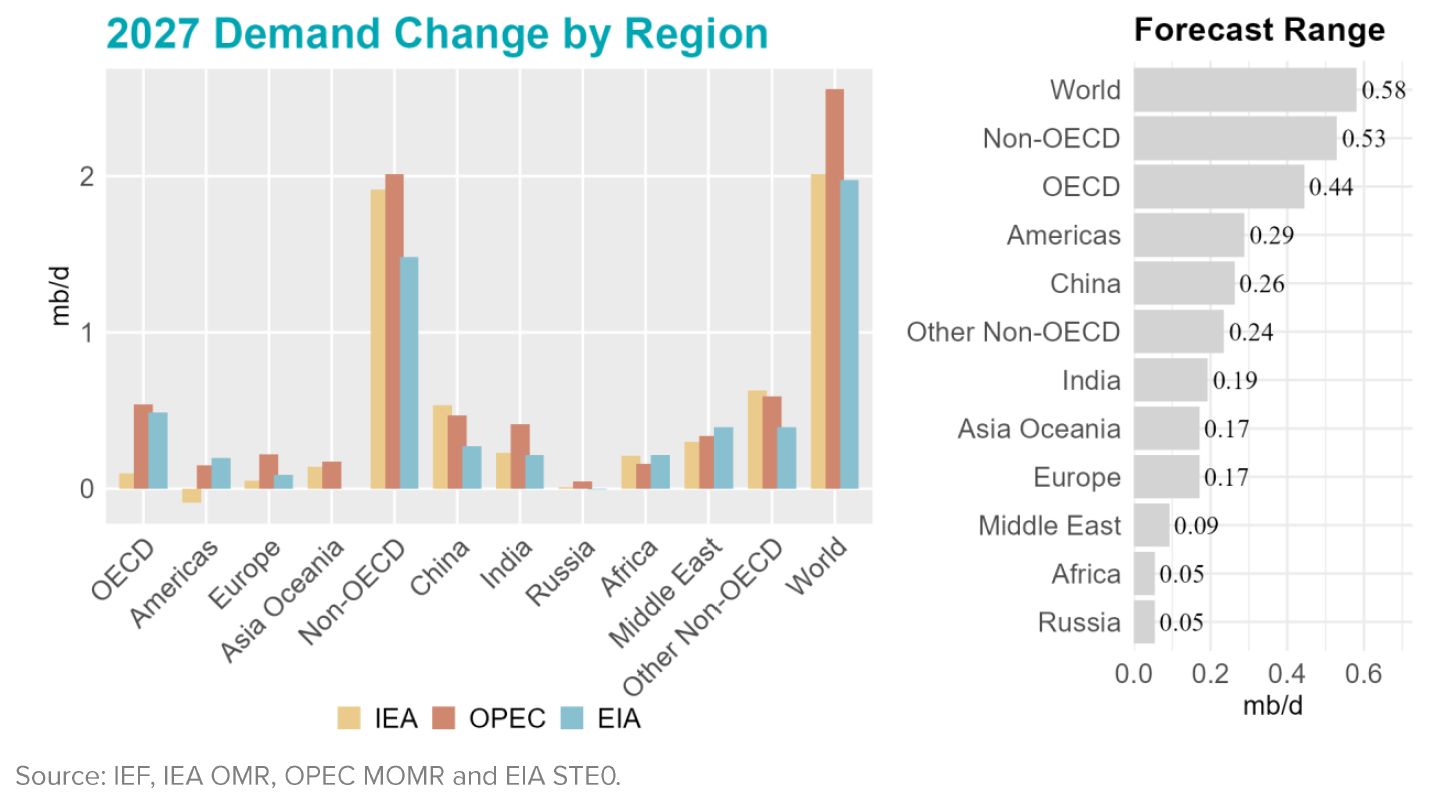
The three outlooks anticipate a recovery in global oil demand in 2027, with annual growth ranging from 2.0 mb/d under the IEA and EIA to 2.6 mb/d under OPEC. Non-OECD economies drive most of the expansion, contributing between 1.5 and 2.0 mb/d, while OECD demand increases by just 0.1 to 0.5 mb/d. Despite relatively similar growth expectations, global consumption levels remain widely separated, reaching 108.3 mb/d under OPEC, compared with 104.4 mb/d under the EIA and 104.3 mb/d under the IEA. The latest monthly revisions leave OPEC's annual estimate unchanged, while the EIA and IEA lower their projections by 0.3 mb/d and 0.1 mb/d, respectively.
Demand growth across non-OECD economies in 2027 is supported by contributions from several major markets, led by China, where increases range from 0.27 mb/d under the EIA to 0.54 mb/d under the IEA. India adds between 0.22 and 0.41 mb/d, while the Middle East contributes 0.30 to 0.39 mb/d across the three outlooks. Africa records relatively consistent growth of 0.16 to 0.22 mb/d, with other non-OECD economies accounting for an additional 0.39 to 0.63 mb/d.