
IEF17: Reflections of the IEF Secretary General
The most powerful message from the 17th International Energy Forum Ministerial was perhaps delivered before anyone took the floor: the determination to come together in Riyadh, even when circumstances made doing so extraordinarily difficult.


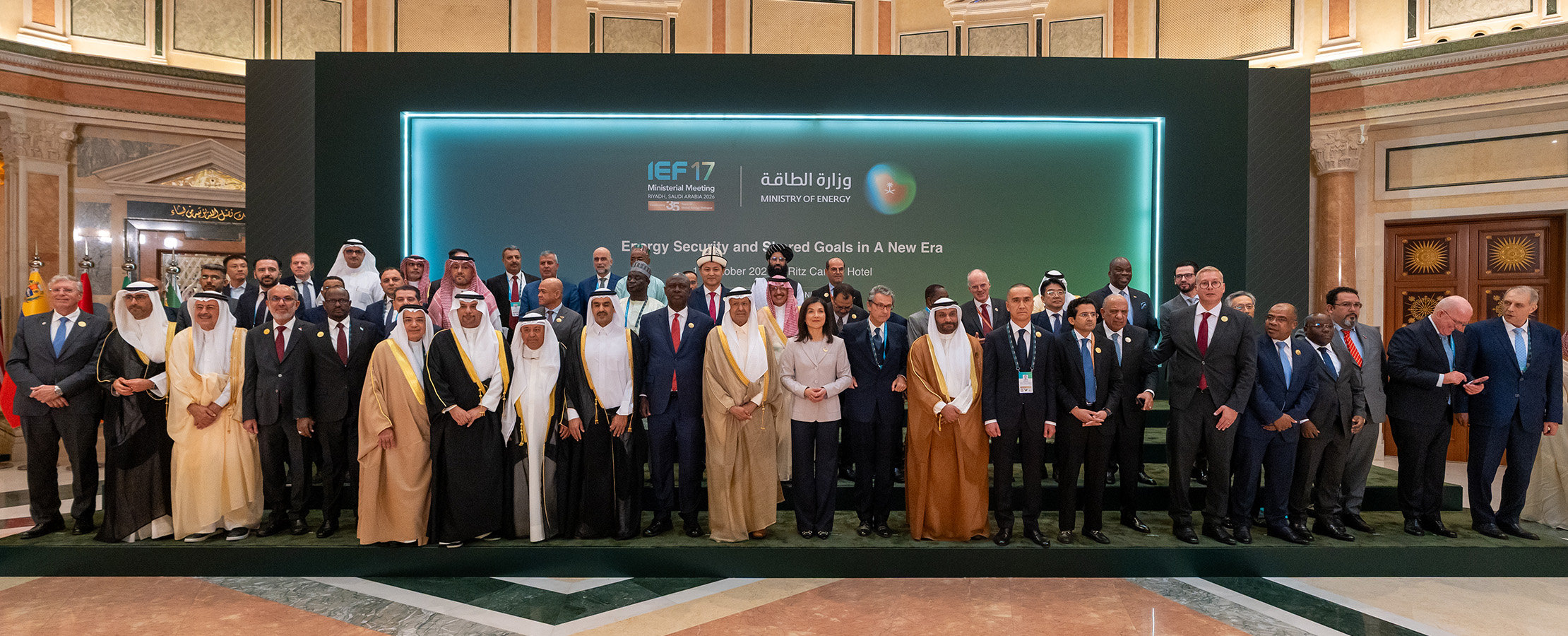
On 11 October, Energy Ministers and senior government representatives, CEOs and industry leaders, heads of international organizations and distinguished experts gathered in Riyadh for IEF17, united by a conviction that dialogue matters most when it is hardest to sustain.
Above all, this was a demonstration of the leadership and commitment of our Ministers.
This year marks the 35th anniversary of the producer–consumer energy dialogue, first convened at Ministerial level in 1991.
The IEF grew from that dialogue and remains, first and foremost, a forum created by Ministers, for Ministers - led by its Member Countries and guided by their priorities.
Today, our 67 Member Countries are home to nearly three-quarters of the world's population.
It is their energy security, their livelihoods and their aspirations for a better future that give our dialogue its ultimate purpose.
To everyone who made the journey to Riyadh, often overcoming considerable obstacles and uncertainty, I extend my deepest appreciation. To those who made every effort to join us but ultimately could not, your commitment was equally valued, and you were missed.
Your determination demonstrated something more significant than the success of a Ministerial meeting. It reaffirmed our unity of purpose and shared responsibility for global energy security.
At the same time, our thoughts remain with the families who have lost loved ones, and with the people of Saudi Arabia and across the region affected by these difficult events.
I am profoundly grateful to our host, the Kingdom of Saudi Arabia, and particularly to HRH Prince Abdulaziz bin Salman bin Abdulaziz Al Saud, whose leadership, vision, and unwavering commitment to international energy cooperation made this gathering possible.
My heartfelt thanks go to our colleagues at the Saudi Ministry of Energy for their exceptional dedication, professionalism, and hospitality in extraordinarily demanding circumstances.
Their efforts, together with those of my outstanding colleagues at the IEF Secretariat and everyone involved in preparing and delivering IEF17, deserve special recognition.
The Kingdom's commitment to our work was further demonstrated on 12 October, when, in the presence of HRH Prince Abdulaziz, I was pleased to sign a Memorandum of Understanding between the IEF and the Saudi Ministry of Energy, on the sidelines of the 25th WPC Energy Congress.
The agreement establishes a framework to deepen cooperation on clean energy, climate change mitigation, and Circular Carbon Economy (CCE) solutions, including the Regional
CCE Cooperation Initiative. It reflects our shared commitment to advancing practical cooperation across energy technologies and systems.
I extend my sincere appreciation to our IEF17 co-hosts, Italy and Nigeria, represented by H.E. Gilberto Pichetto Fratin and H.E. Senator Heineken Lokpobiri, for their leadership, partnership and steadfast support for international energy dialogue.
I want to express appreciation to the CEOs, companies and industry leaders who joined our Ministers in Riyadh.
Their presence, especially in such challenging circumstances, demonstrated the importance they attach to sustained engagement between governments and industry.
Energy security cannot be achieved through government policy alone, nor through industry investment and innovation in isolation.
Governments establish the frameworks within which energy systems develop. Industry brings the capital, expertise, technology, and operational capabilities essential to delivering the energy on which our economies and societies depend.
Each needs to understand the priorities, opportunities and constraints facing the other.
The IEF's Industry Advisory Council (IAC) provides an essential bridge between these perspectives.
Through the Council, companies from across the global energy value chain contribute practical knowledge and experience to inform the Ministerial dialogue and support the priorities established by our Member Countries.
It is a relationship that extends well beyond individual Ministerial meetings, strengthening mutual understanding, investment confidence, and our capacity to respond to shared challenges.
I am especially pleased that Hitachi Energy and EDF power solutions chose this Ministerial week to announce their membership of the IAC. Their expertise in electricity infrastructure, renewable energy, technology and integrated power systems further broadens the Council's contribution to our dialogue across all energy sources and technologies.
To all our industry partners, thank you. Your voice enriches the dialogue among our Ministers, your expertise strengthens its substance, and your continued engagement helps translate shared priorities into practical progress.
My sincere appreciation also goes to our distinguished moderators, Daniel Yergin and Amrita Sen, whose expertise and skilful guidance helped ensure substantive, focused and forward-looking discussions.
I am equally grateful to our longstanding trilateral partners, OPEC and the IEA, and particularly to H.E. Haitham Al Ghais, Secretary General of OPEC, and his team, and Dr. Fatih Birol, Executive Director of the IEA.
Their continued partnership is invaluable to strengthening dialogue, market transparency and mutual understanding, particularly where energy outlooks and perspectives differ.
Riyadh Energy Week also allowed us to strengthen our partnerships with other International Organizations. My thanks go to Pedro Miras, President of WPC Energy, and Director General Burcu Gunal, for their support and for WPC Energy’s active and sustained engagement in the global energy dialogue.
I was equally pleased that the 17th Clean Energy Ministerial and 11th Mission Innovation Ministerial convened in Riyadh alongside IEF17. Our partnership with the CEM continues to deepen, and the IEF is glad to support the discussions on the Belém 4X Pledge to quadruple sustainable fuel production and use by 2035, launched at COP30 by Brazil, Italy, India and Japan and now endorsed by some 29 countries. Sustainable fuels are one further example of how cooperation across all energy sources, technologies and systems can advance security, affordability and sustainability together.
What emerged from Riyadh was not uniformity of views. Nor should it be. It was something more important: recognition that energy security cannot be achieved in isolation.
Our energy markets, economies and societies are deeply interconnected. Security of supply and security of demand are mutually reinforcing.
Protecting energy infrastructure and trade routes, strengthening resilience and ensuring the reliable and affordable flow of energy are interests we all share.
The discussions under the theme Energy Security and Shared Goals in a New Era gave practical substance to that understanding.
They highlighted the importance of sustained investment across all energy systems; more diversified and resilient supply chains; stronger collective preparedness; predictable policies that support investment and trade; and energy pathways that advance security, affordability and sustainability while respecting different national circumstances.
These are challenges that demand cooperation between governments, industry and international organizations - not because their perspectives are identical, but because their responsibilities and interests are interconnected.
We also welcomed important progress in strengthening energy market transparency, including the JODI Roadmap 2026–2030, endorsed by the JODI Partner Organizations ahead of the Ministerial.
Our continuing collaboration with the IEA and OPEC will further strengthen transparency and understanding of energy outlooks, market fundamentals and the conditions needed to support investment.
Thirty-five years after the dialogue began, IEF17 reaffirmed why it remains indispensable.
Our Member Countries span every region, different stages of economic development and both established and emerging energy supply chains. Their circumstances and priorities differ, but their Ministers recognise the value of coming together to understand one another and identify opportunities for cooperation.
Even when perspectives differ, engagement builds understanding. Understanding strengthens confidence. And confidence enables the investment, cooperation and preparedness on which lasting energy security depends.
I am equally encouraged by the continuity of that commitment.
As Saudi Arabia concludes its chairmanship of the IEF Executive Board, we express our profound appreciation for the Kingdom's longstanding stewardship and warmly welcome Italy as the incoming Chair.
While the chairmanship passes to Italy, Saudi Arabia remains the permanent host of the IEF Secretariat in Riyadh, providing an enduring institutional home for the Ministerial dialogue and a foundation for its continued development.
With Türkiye and Japan taking our dialogue forward through the 10th Asian Ministerial Energy Roundtable in 2027, Italy hosting IEF18 with Türkiye as co-host in 2028, and Türkiye hosting IEF19 in 2030, we have a clear path for sustaining and advancing the cooperation strengthened in Riyadh.
Above all, I leave IEF17 with renewed confidence in the determination of our Ministers and Member Countries to uphold the spirit of dialogue, even amid profound uncertainty, and in the commitment of our industry partners and international organizations to support that shared purpose.
Thirty-five years after our Ministers began this dialogue, IEF17 reminded us that its greatest strength lies not in the absence of differences, but in the determination to engage across them.
From Riyadh to Rome, we must sustain that determination—strengthening cooperation, building confidence and advancing the energy security on which more than six billion people in our Member Countries, and billions more beyond them, depend.
Our Ministers lead this dialogue. Our partners strengthen it. And the people whose futures depend on secure, affordable energy give it its purpose.
