
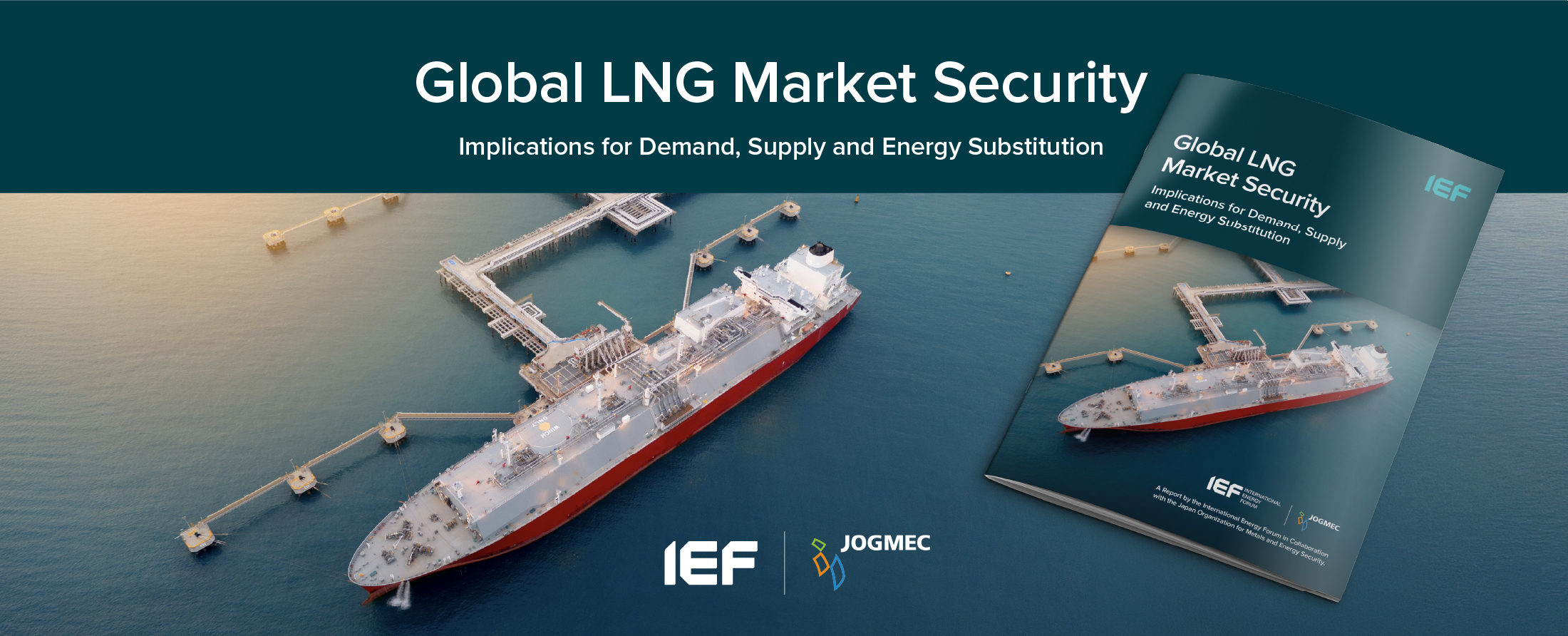
Global LNG Market Security
Implications for demand, supply and energy substitution
A report by the International Energy Forum in collaboration with the Japan Organization for Metals and Energy Security
September 2026


Overview
Liquefied Natural Gas (LNG) has become an increasingly important component of global energy trade, enabling natural gas to be transported beyond the constraints of pipeline infrastructure and strengthening the integration of geographically distant producers and consumers. Alongside its expanding role in energy systems, LNG has been positioned both as a transition fuel in decarbonization pathways and as a strategic asset for enhancing energy security. However, recent supply disruptions, price volatility, and geopolitical tensions expose vulnerabilities in global LNG markets, highlighting growing interdependence between exporters and importers while raising important questions about the resilience of future demand and supply expansion.
This IEF report contributes to deepening producer-consumer market insight by developing the first global harmonized and balanced bilateral LNG trade dataset spanning 2000-2024, covering trade flows among 144 countries at the country-pair level. The dataset integrates multiple national and international statistical sources through a systematic harmonization framework to produce a consistent historical record of global LNG trade. This database provides the basis for projecting trade flows through 2031. The work incorporates projections of economic activity and population growth, planned LNG infrastructure expansion, shipping capacity, historical patterns of natural gas use in electricity generation, and key energy demand indicators.
The analysis indicates that global LNG demand is expected to remain strong and increase through 2031, with the pace of growth varying substantially with macroeconomic conditions. By combining a harmonized historical trade database with a transparent framework to inform projections, this report provides a comprehensive assessment of evolving global LNG trade patterns and offers new insights into their implications for energy security, market development, and broader energy and climate policy objectives.
"LNG has moved from the margins of the gas market to the center of the global energy security agenda. Its share of global primary energy demand has nearly tripled, while global LNG trade has expanded more than fourfold over the same period."

Jassim Alshirawi
Secretary General, IEF
Key Findings
Key findings of the report include:
- Natural gas now powers around one in every four units of electricity generated worldwide.
- Gas-fired generation has grown nearly 1.5 times faster than electricity demand over the past two decades.
- Energy security concerns increased LNG’s strategic role, positioning it as a new growing pillar of global energy security.
- Global LNG trade grows by an average of 6% per year, expanding more than fourfold over just 26 years.
- LNG supply remains concentrated while demand continues to diversify, creating an asymmetric market structure.
- Diversification has strengthened resilience, but physical and “virtual” chokepoints continue to shape LNG supply security.
- Direct exposure varies by market, but vulnerability is shaped by both concentration and scale.
- The global LNG market transmits shocks widely, but their price effects diverge sharply across regions.
- Near-term growth in global LNG demand remains robust despite substantial uncertainty in future geoeconomic, policy and regulatory conditions.
- Regional dialogue and cooperation on global LNG market trends, strengthens energy security and reduces exposure to market volatility and disruptions.
Key Charts
Gas-fired electricity generation by region and total electricity demand, 2000-2024
Gas share of electricity generation, 2000 vs 2024
Natural Gas Share in Global Primary Energy Demand
In the Media
-
IndexBox
Global LNG Demand to Reach 800 Bcm Annually by 2031, IEF Report Finds
16 September 2026
-
OGN News
Global LNG trade could reach 800 bcm by 2031, IEF-JOGMEC report says
15 September 2026
-
Quantum Commodity Intelligence
LNG trade seen reaching 800 Bcm by 2031 despite supply risks
15 September 2026
-
S&P Global Commodity Insights
Global LNG trade seen rising 200 Bcm/year by 2031
15 September 2026
About the International Energy Forum
The International Energy Forum (IEF), the global home of energy dialogue, is the trusted and neutral intergovernmental platform for energy dialogue among member states, industry leaders, and experts. Its Ministers represent producing, consuming, and transit countries in every region, at every stage of economic development, and across both established and emerging energy-system supply chains. The IEF advances global energy security through open and inclusive dialogue spanning all fuels, technologies, and systems.
About Japan Organization for Metals and Energy Security (JOGMEC)
JOGMEC is committed to securing stable supplies of resources and energy to Japan and to achieving carbon neutrality. In 7 types of projects - oil and natural gas, hydrogen, CCS, geothermal, offshore wind power, metals, and coal - we support Japanese companies in acquiring interests by conducting eight businesses, including geological surveys, marine resource development, technological development, and financial assistance.
